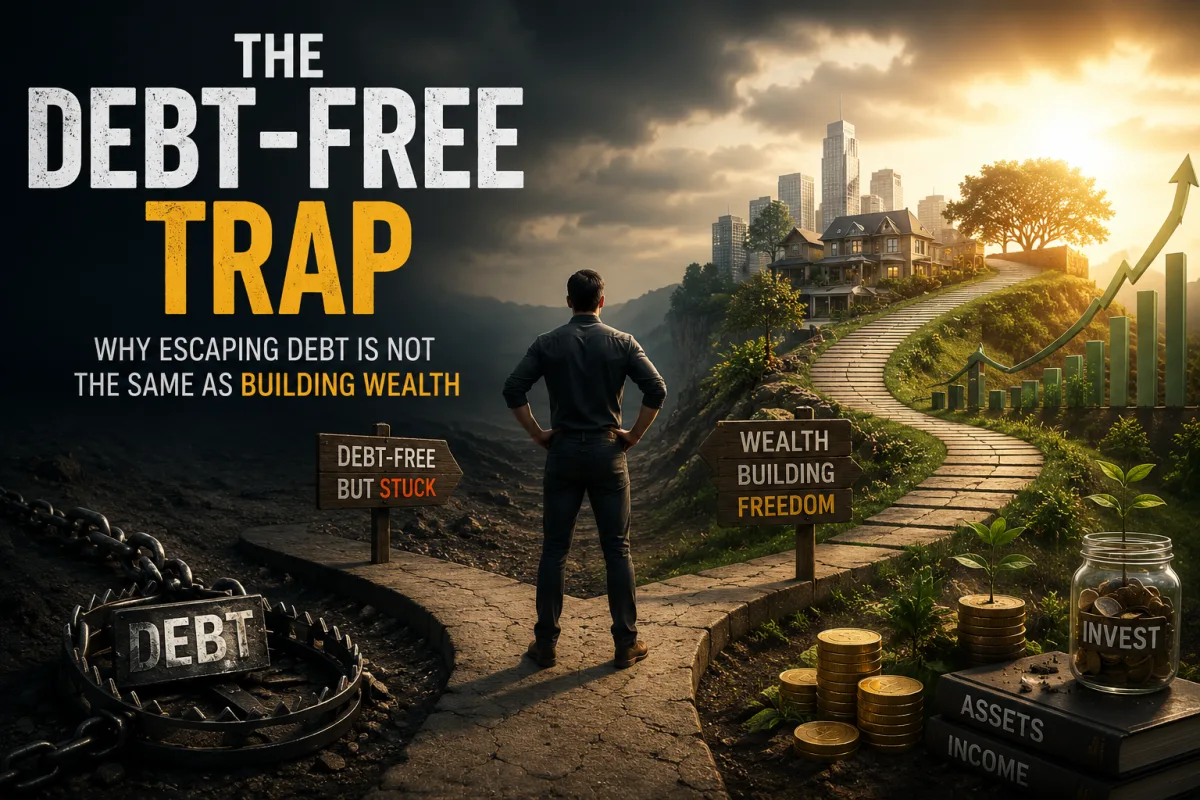
The Debt-Free Trap: Why Escaping Debt Is Not the Same as Building Wealth
Being debt-free is only half the battle.
For many people, paying off debt feels like reaching the financial mountaintop. The credit card balance is gone. The personal loan is closed. The car loan is finished. The mobile loans, overdrafts or salary advances are no longer draining every paycheck. For the first time in years, income arrives without being immediately claimed by lenders.
That moment deserves recognition.
Debt freedom can change a person’s life. It can reduce anxiety, restore dignity, free cash flow and give the household breathing room. It can end the exhausting cycle of working today to pay for yesterday. It can prove that discipline works. It can create the first real feeling of control many people have ever had with money.
But debt freedom is not the same as wealth.
It is possible to pay off debt and still remain financially stuck. It is possible to become so afraid of borrowing, investing and risk that all extra money sits in cash for years. It is possible to avoid debt completely but never build assets. It is possible to be financially safer than before while still losing purchasing power quietly to inflation.
This is the debt-free trap.
The debt-free trap happens when the pain of debt becomes so powerful that a person makes fear the center of their entire financial life. After years of payments, interest, shame, collection calls, pressure or financial stress, they promise themselves they will never be trapped again. That promise is understandable. But sometimes it turns into a new problem: they stop taking any financial risk at all.
They hoard cash. They avoid investing. They distrust every financial product. They keep too much money idle. They delay buying productive assets. They believe safety means avoiding all uncertainty. They celebrate having no debt, but years later their net worth has barely grown.
Debt freedom removes a burden. Wealth building requires a new engine.
Cash can protect you from emergencies. But cash alone rarely builds long-term wealth. Inflation gradually reduces what cash can buy. Opportunity costs accumulate. Investment years are lost. Retirement remains underfunded. The person who once paid interest to lenders may now lose value slowly because their money is not growing fast enough.
This does not mean debt is good by default. It does not mean everyone should borrow again. It does not mean investing should be reckless. It means financial progress has stages. The habits that help you escape debt are not always enough to build wealth after debt.
Debt repayment is defense. Wealth building is offense. A strong financial life needs both.
The Emotional Victory of Paying Off Debt
Debt is not only a financial obligation. It is often an emotional weight.
People in debt may feel trapped before the month begins. They may receive income and watch it disappear into minimum payments, penalties, interest and arrears. They may avoid opening messages from lenders. They may feel embarrassed when friends talk about investing or travel. They may feel guilty about past decisions. They may feel unable to plan because every plan is interrupted by repayment demands.
Paying off debt can therefore feel like reclaiming identity.
The person is no longer behind. They are no longer sending money to lenders every month. They are no longer calculating how to survive after payments. They have proof that they can make sacrifices, stay disciplined and complete a difficult financial goal.
This emotional victory matters. It should not be minimized.
But emotional victories can create emotional overcorrections. Someone who suffered through debt may begin seeing all financial risk as dangerous. They may associate investing with loss, borrowing with shame and spending with weakness. They may believe the only safe money is money sitting untouched in a bank account.
This reaction is human. After financial pain, safety feels priceless.
The challenge is that safety has different forms. Having no high-interest debt is safety. Having emergency cash is safety. Having insurance is safety. Having diversified investments is also a kind of safety because it protects long-term purchasing power. Having skills that increase income is safety. Having assets that produce income is safety. Having a retirement plan is safety.
A person who defines safety only as cash may become protected from one kind of risk while exposed to another.
Debt Freedom Is a Starting Line, Not a Finish Line
Paying off debt changes the financial question.
While in debt, the question is often, “How do I stop the bleeding?” The focus is repayment, interest reduction, spending control and avoiding new balances. That phase requires intensity. It rewards discipline, sacrifice and simplicity.
After debt is gone, the question changes: “What should my freed cash flow build?”
This is where many people get stuck. The old debt payment disappears, but the money has no new assignment. Some people absorb it into lifestyle. Others let it pile up in cash without a plan. Some relax too much and drift back into old spending. Others become so cautious that they avoid all growth.
The moment after debt repayment is one of the most important financial transitions in a person’s life.
Imagine someone who was paying $500 per month toward debt. Once the debt is gone, that $500 becomes available. If it disappears into lifestyle, the person becomes more comfortable but not necessarily wealthier. If it sits in cash forever, it may create emotional comfort but limited growth. If it is redirected into emergency savings, retirement accounts, diversified investments, business capital or asset ownership, it can become the foundation of wealth.
Debt freedom creates financial margin. Margin must be directed.
Without direction, the freed payment loses power. With direction, the old debt payment becomes an investment contribution. The money that once made lenders richer can begin building the household’s future.
The Hidden Danger of Hoarding Cash
Cash feels safe because the number does not move much.
If you have $20,000 in a bank account today, you may still see $20,000 tomorrow. Unlike stocks, it does not fluctuate visibly every hour. Unlike property, it does not require tenants or repairs. Unlike a business, it does not depend on customers. Cash is simple. Cash is liquid. Cash is comforting.
But cash has a hidden weakness: purchasing power.
If prices rise over time, the same amount of cash buys less. Rent rises. Food rises. Transport rises. Medical costs rise. Education costs rise. Insurance rises. The bank balance may remain stable, but the real value may decline. This is inflation doing quiet damage.
Inflation is especially dangerous because it does not feel like a sudden loss. If an investment falls 20 percent, the loss is visible. If inflation reduces purchasing power gradually, the loss is experienced as life becoming more expensive. People blame prices, but the financial effect is the same: cash buys less than it used to.
This is why hoarding cash after debt repayment can become a trap.
Cash is necessary. A person should have emergency savings. A household should keep money for short-term obligations. A business should hold reserves. But long-term money sitting permanently in cash may fail to grow enough to preserve purchasing power.
The person feels safe because they see a stable balance. In reality, they may be losing ground slowly.
The Difference Between Emergency Cash and Idle Cash
Not all cash is bad.
Emergency cash is essential. It protects against job loss, medical costs, car repairs, family emergencies, home repairs, delayed income and unexpected expenses. Emergency savings prevent a person from returning to debt when life becomes expensive.
Short-term cash is also useful. Money needed for rent, school fees, taxes, insurance premiums, a home deposit, a planned move or business expenses should not be invested aggressively if it is needed soon. The purpose of short-term money is stability.
The problem is idle cash.
Idle cash is money sitting without a purpose beyond fear. It is not needed for emergencies. It is not assigned to a near-term goal. It is not part of a business reserve. It is not waiting for a planned expense. It is simply parked because the owner is afraid to invest.
Idle cash often begins as caution and becomes procrastination.
A useful question is: what job does this cash have?
If the answer is “emergency fund,” keep it safe. If the answer is “school fees due in six months,” keep it liquid. If the answer is “tax reserve,” protect it. If the answer is “I am scared to invest and do not know what else to do,” the money may need a plan.
Every dollar should have a role. Cash is a role. But cash should not be the only role.
Why Inflation Punishes Excess Cash
Inflation is the rising cost of goods and services over time.
When inflation occurs, the same amount of money buys fewer goods and services. If your money earns less than inflation, you are losing purchasing power. The loss may not appear as a negative balance, but it appears in the real world when the same income or savings no longer covers the same life.
This matters after debt repayment because many debt-free people become proud of large cash balances. That pride is understandable. After years of debt, seeing money accumulate feels like healing. But the healing can become harmful if cash becomes permanent.
Suppose someone holds a large amount in cash for ten years while prices rise significantly. At the end of the decade, the cash may still exist, but it may buy much less. Meanwhile, investments that could have grown may have been avoided completely.
The cost of hoarding cash is not always visible in a statement. It is visible in missed compounding.
Money invested in productive assets has the potential to grow, produce income and protect purchasing power over time. It can also fluctuate and lose value, which is why investment decisions must match time horizon and risk tolerance. But refusing to invest any long-term money leaves inflation unchallenged.
Inflation turns excessive cash into a slowly melting asset.
The Fear That Follows Debt
Many people who escape debt carry financial trauma.
They remember the stress of owing. They remember the shame of borrowing. They remember the arguments, sacrifices, declined transactions, collection notices or sleepless nights. After escaping, they want certainty. They do not want anything that feels like risk.
This fear can be protective at first. It prevents reckless borrowing. It encourages saving. It strengthens spending discipline. It makes the person more cautious.
But fear becomes expensive when it prevents growth.
A debt-free person may avoid investing because investments can fall. They may avoid business opportunities because businesses can fail. They may avoid property because tenants can leave. They may avoid career risks because income could change. They may avoid every decision that involves uncertainty.
The result is financial stillness.
But there is no such thing as a life with no financial risk. Cash has inflation risk. Jobs have layoff risk. Businesses have customer risk. Investments have market risk. Debt has repayment risk. Property has maintenance risk. Retirement has longevity risk. Health has medical cost risk.
The goal is not to eliminate risk. The goal is to choose and manage the right risks.
Debt taught the person that unmanaged obligations can be dangerous. The next lesson is that unmanaged caution can also be dangerous.
Debt Freedom Without Asset Ownership
A person can be debt-free and still own very little.
This is one of the most overlooked realities in personal finance. Having no debt improves net worth because liabilities are gone. But if assets are not growing, wealth remains limited.
A debt-free person with no emergency fund, no investments, no retirement savings, no property equity, no business assets and no income-producing holdings is financially cleaner than before, but not financially strong. They may have no creditors, but they also have no engine.
Asset ownership is what moves a person from stability to wealth.
Assets may include diversified investment funds, retirement accounts, shares, bonds, real estate, business equity, intellectual property, cash-flowing systems, pension assets or other productive holdings. The exact assets depend on the person’s country, age, goals, risk tolerance and knowledge. But the principle is universal: long-term wealth requires owning something that can grow or produce income.
Debt freedom stops money from flowing backward. Asset ownership helps money flow forward.
The Psychological Comfort of a Large Bank Balance
A large bank balance can feel like proof of success.
After debt repayment, seeing cash accumulate may feel better than watching an investment portfolio fluctuate. The money is visible. It is available. It creates emotional security. For someone who once felt trapped by debt, this comfort can be powerful.
There is nothing wrong with enjoying that comfort. The problem begins when the comfort becomes the plan.
Bank balances are easy to understand. Investment portfolios require education. Cash feels certain. Markets feel uncertain. Cash does not require patience. Investing does. Cash does not force a person to confront volatility. Investing does.
But wealth rarely grows from comfort alone.
The debt-free person must learn to distinguish between emotional safety and financial strategy. Emotional safety says, “I want all my money where I can see it.” Financial strategy asks, “Which money needs to be liquid, and which money needs to grow?”
The answer will not be the same for every dollar.
Some money should remain liquid. Some should be invested. Some should be reserved for taxes. Some should fund sinking funds. Some should protect family. Some should build long-term wealth.
A large bank balance may be comforting, but a well-structured financial system is stronger.
The Proper Order After Paying Off Debt
The period after debt repayment needs a clear sequence.
First, confirm that destructive debt is truly gone. If credit cards, payday loans, high-interest personal loans, overdrafts or consumer financing remain, continue the debt strategy. Debt freedom means the expensive debt cycle has stopped.
Second, build or complete an emergency fund. This prevents future emergencies from recreating debt. The fund should reflect real expenses and risks. A single person with stable income may need less. A family with children, variable income or one breadwinner may need more.
Third, create sinking funds for predictable expenses. Annual insurance, school fees, car repairs, medical costs, holidays, property maintenance and taxes should not invade the emergency fund. Save for them separately.
Fourth, begin investing consistently. This may include retirement accounts, pension contributions, diversified funds, bonds, shares, real estate or other assets suitable to the person’s situation. The key is to move long-term money into growth-oriented vehicles.
Fifth, protect the plan with insurance and risk management. Debt freedom can be reversed by uninsured emergencies.
Sixth, increase income and keep lifestyle growth controlled. Debt freedom creates breathing room, but income growth creates acceleration.
Seventh, track net worth. Watch assets rise and liabilities remain controlled.
This sequence turns debt freedom into wealth building.
Why Investing Feels Difficult After Debt
Investing after debt can feel emotionally difficult because it reintroduces uncertainty.
Debt repayment is clear. You owe a balance. You pay it down. The number falls. Progress is visible and predictable. Investing is different. You contribute money, but the value may rise or fall in the short term. A month of investing can end with a lower balance despite doing the right thing.
This can feel unfair to someone who has just escaped debt. They may think, “I worked so hard to get control. Why would I put money somewhere it can fall?”
The answer is time horizon.
Money needed soon should not be placed in volatile investments. But long-term money has a different job. Its job is not to remain perfectly stable next month. Its job is to grow over years and decades. Short-term volatility is the price investors often pay for long-term return potential.
The debt-free person must learn a new kind of discipline. Debt repayment discipline is about attacking a fixed obligation. Investing discipline is about staying committed to a plan despite fluctuation.
Both require patience. But they feel different.
From Debt Aversion to Risk Intelligence
Debt aversion is understandable after painful borrowing.
A person may decide never to borrow again. In many cases, avoiding consumer debt is wise. But the broader goal should not be blind debt avoidance. It should be risk intelligence.
Risk intelligence means understanding the difference between destructive debt, strategic debt, investment risk, inflation risk, liquidity risk and behavioral risk.
Destructive debt funds consumption and charges high interest. It usually weakens wealth. Strategic debt may help acquire an asset, build a business or increase earning power, but only if the numbers and risks are carefully managed. Investment risk is the possibility that asset values fluctuate or decline. Inflation risk is the loss of purchasing power. Liquidity risk is not having cash when needed. Behavioral risk is making poor decisions because of fear, greed or impatience.
A financially mature person does not treat all risk as equal.
They avoid destructive debt. They keep emergency cash. They invest long-term money. They diversify. They insure major risks. They avoid speculative promises. They learn before committing capital. They do not let fear make every decision.
The goal after debt freedom is not to become fearless. It is to become financially wise.
The Role of an Emergency Fund
An emergency fund is the first defense against returning to debt.
After paying off debt, many people should focus on building a full emergency fund before investing aggressively. This is especially true if they have unstable income, dependents, weak insurance, high fixed expenses or limited family support.
The emergency fund should cover essential expenses, not luxury spending. Essential expenses include housing, food, utilities, transport, insurance, minimum obligations, medication and basic family needs. The target may be three to six months of essential expenses, or more for highly variable income.
This fund should be held in safe, accessible places. It should not be invested in volatile assets. Its purpose is protection, not high return.
But once the emergency fund is complete, continuing to put all surplus into cash may become inefficient. The emergency fund is a foundation. It is not the whole house.
Build the foundation strong enough, then build above it.
The Role of Investing
Investing is how debt-free income becomes wealth.
When debt payments disappear, the freed cash flow can be redirected toward assets. Investments may include broad market funds, retirement accounts, pension plans, bonds, treasury instruments, dividend-paying shares, real estate investment trusts, rental property, business ownership or other suitable assets.
The right investment depends on personal circumstances. A young investor may have a longer time horizon and tolerate more market volatility. Someone near retirement may need more stability. A business owner may need liquidity and diversification. A parent may need to balance education costs with retirement.
The important shift is moving from repayment to accumulation.
Debt repayment reduces liabilities. Investing increases assets. Net worth grows faster when both sides improve: liabilities stay low and assets rise.
Investing should not be done blindly. Learn the basics. Understand fees. Consider taxes. Diversify. Match investments to goals. Avoid putting emergency money into volatile assets. But do not use the need for education as an excuse for permanent delay.
The debt-free person who never invests may avoid market losses, but they also avoid market growth.
The Role of Retirement Planning
Debt freedom can create a false sense of retirement security.
A person may think, “At least I do not owe anyone.” That is valuable, but retirement requires more than having no debt. Retirement requires income or assets that can support life when active work slows or stops.
Someone can enter retirement debt-free and still struggle if they have insufficient savings, investments, pension income or income-producing assets. No debt lowers expenses, but it does not automatically pay for food, healthcare, housing, transport, family support or emergencies.
After debt repayment, retirement contributions should become a priority. If an employer offers a retirement match or pension benefit, understand it. If individual retirement accounts, pension schemes or tax-advantaged accounts are available, evaluate them. If self-employed, create a retirement system rather than assuming the business will always support you.
The old debt payment can become the retirement contribution.
This is one of the cleanest financial transitions: the money that once went to lenders now goes to your future self.
The Role of Inflation-Protected Thinking
After debt freedom, financial planning must account for inflation.
Inflation affects future expenses. Retirement costs may be higher than today’s costs. Education costs may rise. Medical costs may rise. Rent, food, insurance and transport may become more expensive over time.
A financial plan that holds too much long-term money in cash may underestimate this reality. The person may believe they are preserving wealth, but they may be preserving only the number, not the purchasing power.
Inflation-protected thinking asks: will this money grow enough to buy what I need in the future?
For emergency funds, the answer may be less important because the money is for short-term protection. For retirement money, education money and long-term wealth, the answer is critical. Those funds usually need some exposure to assets with growth potential.
Inflation is not solved by fear. It is solved by planning.
When Cash Hoarding Makes Sense
There are times when holding extra cash is reasonable.
If income is unstable, more cash may be necessary. If a job loss is likely, cash provides protection. If a family has medical uncertainty, liquidity matters. If a home purchase is near, the deposit should not be exposed to market volatility. If a business has seasonal revenue, reserves are essential. If someone recently escaped debt and is rebuilding emotional stability, a larger cash buffer may be temporarily useful.
The issue is not cash itself. The issue is cash without purpose or time limit.
A person may decide to hold extra cash for 12 months while stabilizing after debt repayment. That is a plan. Another may hold cash for a known property purchase in 18 months. That is a plan. Another may hold six months of expenses because their business income varies. That is a plan.
But holding all surplus cash for ten years because investing feels uncomfortable is not a strategy. It is fear.
Cash should be intentional. Once its purpose is fulfilled, excess money should be directed toward growth.
When Investing Should Wait
Investing should not always begin immediately after the final debt payment.
If there is no emergency fund, build one first. If high-interest debt remains, prioritize repayment. If income is unstable and bills are at risk, stabilize cash flow. If insurance gaps could create catastrophe, review protection. If money is needed within a short period, keep it safe. If an investment is not understood at all, pause and learn.
Investing should begin from a foundation, not panic or pressure.
The danger is swinging from debt repayment intensity into investment speculation. Some people finish paying debt and feel behind. They want to catch up quickly. They chase risky investments, high-return promises, trading schemes or leveraged opportunities. That is not wealth building. That is emotional overcorrection in another direction.
The right approach is measured. Build safety first. Learn. Start simple. Invest consistently. Increase over time.
The Debt-Free Person’s New Budget
After debt repayment, the budget should be redesigned.
The debt category should not simply disappear into lifestyle. It should be reassigned. A good post-debt budget may include emergency savings, sinking funds, retirement contributions, investment contributions, insurance, giving, education, business capital and controlled lifestyle spending.
For example, if $700 per month was going to debt, the new plan might direct $300 to investments, $200 to emergency savings until fully funded, $100 to sinking funds and $100 to lifestyle improvement. Once the emergency fund is complete, more can shift to investments.
The exact amounts depend on income and goals. The principle is that the old debt payment must remain productive.
This prevents lifestyle creep. It also preserves the discipline developed during debt repayment. The person already proved they can live without that money. Now the money can build assets instead of paying lenders.
Debt freedom creates a chance to upgrade the balance sheet before upgrading lifestyle.
How to Start Investing Without Panic
A debt-free person who fears investing should start with education and structure.
First, define goals. Is the money for retirement, education, home purchase, wealth building, financial independence or income generation? The goal determines the time horizon.
Second, separate short-term and long-term money. Short-term money stays safe. Long-term money can be invested for growth.
Third, learn basic asset classes. Understand stocks, bonds, funds, cash, property, retirement accounts and fees. You do not need expert-level knowledge to begin, but you need enough to avoid blindly following hype.
Fourth, start with diversification. Broad funds or professionally managed diversified options may be easier than picking individual stocks. The exact tools depend on your country and access.
Fifth, automate small contributions. Starting small reduces fear. As confidence grows, contributions can increase.
Sixth, expect volatility. Investment balances will move. This is normal. Money needed soon should not be there. Long-term money should be given time.
Seventh, review periodically, not obsessively. Constant checking can increase anxiety.
The first goal is not to become a sophisticated investor overnight. It is to begin turning debt-free cash flow into ownership.
The Difference Between Saving and Investing
Saving and investing are both necessary, but they serve different purposes.
Saving is for stability and short-term goals. It protects money from immediate risk and keeps it accessible. Emergency funds, rent money, tax reserves and near-term expenses belong in savings or cash-like instruments.
Investing is for growth and long-term goals. It accepts some level of uncertainty in exchange for the possibility of higher returns over time. Retirement, long-term wealth, financial independence and future income often require investing.
The debt-free trap happens when a person treats every goal like a savings goal.
They save for emergencies. Good. They save for annual expenses. Good. Then they save for retirement only in cash. They save for long-term wealth only in cash. They save for financial independence only in cash. At that point, saving has been asked to do a job better suited for investing.
Financial maturity is knowing which tool fits which goal.
The Role of Productive Risk
Wealth building requires productive risk.
Productive risk is risk taken with understanding, preparation and a reasonable expectation of reward. Investing in a diversified portfolio for a 20-year goal is productive risk. Building a business after researching customer demand is productive risk. Buying a rental property after analyzing cash flow is productive risk. Developing skills to increase income is productive risk.
Reckless risk is different. Borrowing heavily to speculate is reckless. Investing in something you do not understand because a friend promised high returns is reckless. Putting emergency money into volatile assets is reckless. Concentrating all wealth in one unproven opportunity is reckless.
The debt-free person must learn to avoid reckless risk without avoiding productive risk.
This distinction is crucial. Financial growth usually involves some uncertainty. The answer is not to hide from uncertainty. The answer is to study it, size it, diversify it and manage it.
Debt-Free but Still Poor
It is possible to be debt-free and still poor.
This statement may sound harsh, but it is important. Debt freedom means liabilities are low or absent. Poverty or financial weakness can still exist if income is low, assets are absent, emergency savings are weak, health risks are uninsured and long-term investments are missing.
Debt freedom is one part of financial health. It is not the whole body.
A person with no debt and no assets may have less pressure than before, but they may not have freedom. They may still depend entirely on the next paycheck. They may still be unable to retire. They may still be vulnerable to emergencies. They may still have no income from ownership.
The purpose of escaping debt is not merely to owe nothing. It is to free money so something better can be built.
The Shift From Borrower to Owner
The most important identity shift after debt repayment is moving from borrower to owner.
The borrower’s income goes to lenders. The owner’s income buys assets. The borrower pays interest. The owner earns dividends, interest, rent, profits or appreciation. The borrower works to satisfy past obligations. The owner works to build future options.
Debt repayment ends the borrower phase. Investing begins the owner phase.
This shift can happen gradually. A person may begin with a retirement account, then diversified funds, then bonds, then a business, then property, then other assets. There is no need to own everything at once. The point is direction.
Every investment contribution says, “My income will not only serve bills. It will buy ownership.”
That is the real escape from financial fragility.
What Wealth Builders Do After Paying Off Debt
Wealth builders do several things after paying off debt.
They keep the discipline. They do not treat debt freedom as permission to spend everything.
They build emergency savings. They know debt can return if cash reserves are weak.
They redirect old debt payments. The payment becomes an investment contribution, savings transfer or asset purchase.
They invest consistently. They understand that debt freedom without investing may lead to stagnation.
They control lifestyle inflation. They improve life gradually without consuming the whole surplus.
They protect against risk. Insurance, cash reserves and legal planning prevent setbacks.
They track net worth. They measure whether assets are rising, not only whether debt is gone.
They keep learning. Debt freedom is one milestone in a larger financial education.
This is the difference between becoming debt-free and becoming wealthy.
The Post-Debt Wealth Plan
A practical post-debt wealth plan can be simple.
First, list the old debt payments. How much cash flow has been freed each month?
Second, assign that amount before lifestyle absorbs it. Decide what percentage goes to emergency savings, sinking funds, retirement, investments, insurance, giving and lifestyle.
Third, complete the emergency fund. Do not leave yourself vulnerable to returning to debt.
Fourth, start investing monthly. Use diversified, understandable investments aligned with long-term goals.
Fifth, increase contributions over time. Every raise, bonus or side income payment should strengthen the plan.
Sixth, maintain debt boundaries. Avoid high-interest consumer debt. Use credit only with discipline, if at all.
Seventh, review net worth every quarter. The goal is to see assets rising.
Eighth, build income. Debt freedom creates room, but income growth accelerates wealth.
Ninth, protect the system. Insurance, estate planning and cash reserves matter.
Tenth, define what wealth is for. Freedom, family, retirement, generosity, business, creativity or peace should guide the plan.
Common Mistakes After Becoming Debt-Free
The first mistake is relaxing too much. Debt freedom feels like victory, but the freed money needs direction.
The second mistake is upgrading lifestyle immediately. Some celebration is fine, but permanent spending can erase the opportunity.
The third mistake is hoarding cash forever. Emergency savings are necessary, but excess idle cash can lose purchasing power.
The fourth mistake is fearing all investing. Avoiding market risk completely can create inflation and retirement risk.
The fifth mistake is chasing risky investments to catch up. Debt freedom should lead to wise investing, not speculation.
The sixth mistake is neglecting retirement. No debt does not automatically create retirement income.
The seventh mistake is failing to insure major risks. One uninsured event can recreate financial crisis.
The eighth mistake is not tracking net worth. Without measurement, progress can stall unnoticed.
The ninth mistake is returning to debt slowly. Small balances can become old patterns.
The tenth mistake is confusing peace with progress. Feeling less stressed is valuable, but wealth still needs to be built.
Final Thoughts
Paying off debt is a major financial victory.
It takes discipline to break the cycle of borrowing. It takes sacrifice to send money to balances instead of lifestyle. It takes courage to face statements, interest, mistakes and habits. Anyone who becomes debt-free has done something meaningful.
But being debt-free is only half the battle.
The next battle is turning freed cash flow into wealth. That requires a different mindset. The goal is no longer only to eliminate liabilities. The goal is to build assets. The goal is not merely to avoid interest payments. It is to earn returns. The goal is not simply to keep money safe from lenders. It is to protect it from inflation, stagnation and missed opportunity.
Hoarding cash out of fear may feel safe, especially after the pain of debt. But excessive cash can quietly lose purchasing power. Years can pass while retirement remains underfunded, investments remain delayed and wealth fails to compound.
The solution is balance.
Keep an emergency fund. Use sinking funds. Avoid destructive debt. Protect against major risks. Then invest long-term money. Buy assets. Reinvest returns. Increase income. Track net worth. Let the old debt payment become the new wealth-building contribution.
Debt freedom gives you breathing room. Investing gives that breathing room direction. Asset ownership gives it power. Compounding gives it time.
The person who escapes debt has already proven discipline. The next step is to aim that discipline at ownership.
Freedom from debt is the doorway. Wealth is what you build after walking through it.

