The Ownership Advantage: Why Investors Build Wealth While Others Consume
Most people are taught to think about money through the lens of income. They ask how much a job pays, how large a raise might be, how much overtime is available, or how quickly they can increase their salary. Income matters. A household without income cannot save, invest, pay down debt, or build financial security. But income alone is not the same as wealth.
The deeper wealth-building question is not only, “How much money do I make?” It is, “What do I own?”
That question changes everything.
Ownership is the quiet force behind most enduring wealth. It is what separates the person who earns from the asset that grows. It is what allows a shareholder to benefit from a company’s expansion, a landlord to receive rent, a business owner to profit from systems and teams, and an investor to compound capital over decades. Income can support a life. Ownership can transform one.
The difference is simple but powerful. Employees exchange time, skill, and effort for compensation. Owners control assets that can produce value even when they are not personally working every hour. An employee may earn a strong salary, but the salary usually depends on continued labor. An owner may earn income from assets, appreciation from growth, and leverage from systems that extend beyond personal effort.
This is not an argument against employment. Many investors begin as employees. Salaries fund savings. Careers build skills. Professional income can be the engine that allows a person to buy assets in the first place. The problem begins when income becomes the entire financial strategy. A high income can create comfort, but without ownership, it may never create lasting wealth.
Ownership changes the direction of financial life. Instead of only working for money, the investor gradually builds a portfolio of assets that can work on their behalf. That shift is one of the most important transitions in personal finance.
What Ownership Really Means
Ownership means controlling an asset that has the ability to produce value. That value may come in the form of income, price appreciation, royalties, equity growth, distributions, or future sale value. The asset may be physical, financial, digital, or intellectual. What matters is that it has productive capacity.
Common ownership assets include businesses, stocks, real estate, intellectual property, investment funds, websites, online brands, software, content libraries, and equity stakes in private companies. Each asset class behaves differently, but they share one important trait: they can create value beyond a single hour of labor.
A share of stock represents partial ownership in a company. A rental property represents ownership of a physical asset that may produce monthly income and appreciate over time. A business represents ownership of a system that can sell products or services. A book, course, patent, music catalog, or software product may represent ownership of intellectual property. A website or digital platform may represent ownership of attention, distribution, and monetizable traffic.
Ownership does not always mean control in the everyday sense. A person who owns shares in a public company does not manage the company’s employees or approve every strategic decision. But that shareholder owns a claim on part of the company’s future. If the company grows more valuable, the shareholder may benefit. If the company pays dividends, the shareholder may receive income. If the market recognizes the company’s earning power, the share price may rise.
That is the heart of ownership. It gives the investor a claim on value creation.
Why Income Alone Often Fails to Build Wealth
Income feels powerful because it is visible. A paycheck arrives. A bonus lands. A client pays an invoice. Money enters the bank account, and the household can immediately spend, save, or invest it. Because income is tangible, many people assume that earning more automatically leads to wealth.
That assumption is incomplete.
A person can earn a high income and still build little wealth if most of the money is consumed. Lifestyle inflation can absorb nearly any raise. A larger home, newer car, more expensive vacations, upgraded subscriptions, frequent dining, private school bills, and luxury spending can expand until income disappears as quickly as it arrives. The person may look wealthy but own very little that produces future value.
This is the income illusion: a high standard of living can be mistaken for financial strength.
Wealth is not measured by how much money passes through a household. It is measured by what remains, what grows, and what can support future choices. Income is a flow. Wealth is a stock. Income is what comes in. Wealth is what stays and compounds.
Ownership turns income into durable financial power. Without ownership, income must be earned again and again. With ownership, a portion of today’s income can be converted into assets that may produce tomorrow’s income. That is the first major shift from consumption to wealth building.
The Employee and the Owner See Money Differently
An employee’s financial life is often built around compensation. The employee thinks about salary, benefits, hours, promotions, bonuses, job security, and retirement contributions. These are important. A strong career can be a tremendous foundation. But the employee’s primary economic asset is personal labor.
The owner’s financial life is built around assets. The owner thinks about equity, cash flow, systems, markets, return on capital, pricing power, debt structure, reinvestment, and long-term value. The owner may still work hard, often harder than expected, but the work is tied to building something that can grow beyond the owner’s direct effort.
Consider a simple comparison.
A skilled employee at a growing technology company may earn a strong salary. Each year, that employee receives compensation for work performed. The company grows, revenue increases, and its market value rises. If the employee owns no equity, the employee benefits mainly through wages and perhaps job stability. The shareholder, by contrast, benefits from the company’s growth itself. The shareholder did not write every line of code, close every sale, or manage every department, but ownership gives that shareholder a claim on the value created by the business.
The same idea appears in real estate. A property manager may earn a wage for managing apartments. The landlord may earn rental income, benefit from loan amortization, and participate in long-term appreciation. The manager is paid for service. The owner participates in the asset’s economics.
In business, an employee may earn a salary from operating a store, while the owner may profit from the store’s systems, brand, inventory, customer relationships, and expansion. If the business opens more locations or improves margins, the owner’s wealth may grow. The employee’s income may rise too, but usually in a more limited way.
This does not make owners better people than employees. It simply shows that they occupy different financial positions. The employee sells labor. The owner holds a claim on assets. Over long periods, that difference can be enormous.
Ownership Separates Wealth From Hours Worked
The most powerful feature of ownership is that it can separate financial results from hours worked. A person has only so many hours in a day. Even a highly paid professional faces a limit. There are only so many clients to serve, shifts to work, surgeries to perform, projects to manage, or meetings to attend.
Labor income is naturally constrained by time, energy, skill, and market demand. Ownership can break through some of those constraints.
A stock portfolio can grow while the investor is sleeping. A rental property can receive rent while the owner is away. A business can sell products through employees, automation, or online systems. A digital course can be purchased by customers in different time zones. A book can earn royalties after it is written. An index fund can distribute dividends without requiring the investor to evaluate every company personally.
This is not effortless wealth. Assets require capital, judgment, maintenance, risk management, and patience. Some assets require years of work before they become productive. Yet once an asset is built or acquired, it may produce value in ways that are not directly tied to the owner’s daily schedule.
That separation is financial leverage.
Leverage is often discussed only in the context of debt, but ownership creates several kinds of leverage. Capital leverage allows money to work through investments. Labor leverage allows a business to use teams. Technology leverage allows software and platforms to serve many users at once. Brand leverage allows reputation to increase pricing power. Time leverage allows an asset built once to create value repeatedly.
Wealth grows when leverage is used responsibly over long periods.
The Five Financial Advantages of Ownership
Ownership creates wealth because it combines several advantages that income alone rarely provides. These advantages are income potential, appreciation potential, tax flexibility, scalability, and compounding.
Income Potential
Many assets can produce recurring income. Stocks may pay dividends. Bonds may pay interest. Rental properties may generate monthly rent. Businesses may produce profits. Investment funds may distribute income. Intellectual property may earn royalties. Digital platforms may generate advertising, subscriptions, licensing fees, or product sales.
Recurring asset income is powerful because it can reduce dependence on a paycheck. At first, the income may be small. A dividend payment may be modest. A rental property may produce limited cash flow after expenses. A new business may reinvest most of its profits. But over time, asset income can become meaningful, especially when profits are reinvested.
The investor’s goal is not necessarily to replace a salary immediately. The goal is to build a second engine. Employment may be the first engine. Ownership becomes the second. When both engines work together, financial momentum improves.
Appreciation Potential
Many ownership assets can become more valuable. A company can increase earnings, develop new products, expand into new markets, and become more profitable. Real estate can appreciate because of location, scarcity, improvements, inflation, population growth, or rising rents. A business can become more valuable as it grows revenue, strengthens margins, builds customer loyalty, and reduces dependence on the founder. A digital asset can increase in value as traffic, subscribers, content, or software utility expands.
Appreciation is different from income. Income is cash received along the way. Appreciation is the increase in the asset’s value. An investor may buy an asset for one price and later own something worth much more.
Appreciation can be uneven. Asset prices rise and fall. Stocks can decline sharply. Real estate can stagnate. Businesses can fail. Digital assets can lose relevance. Ownership is not a guarantee. But over long periods, productive assets have the potential to rise in value because they are tied to real economic activity.
Tax Flexibility
Ownership can create tax advantages that wages do not always provide. The exact rules depend on country, jurisdiction, account type, asset class, and individual circumstances, so investors should seek qualified tax guidance. Still, the broad principle is clear: many tax systems treat different types of income differently.
Wages are often taxed as earned income. Investment gains may be taxed when assets are sold rather than while they are held. Qualified dividends may receive different treatment than ordinary income in some systems. Real estate owners may be able to deduct certain expenses, depreciate buildings, or use tax-advantaged structures. Business owners may deduct legitimate operating costs and choose entity structures that affect taxation.
Tax treatment should never be the only reason to buy an asset. A bad investment does not become good because it has a tax benefit. But when ownership is combined with sound planning, taxes can become part of the wealth-building strategy rather than an afterthought.
Scalability
Scalability means an asset can grow without requiring the same increase in personal labor. A salaried worker who wants to double income may need a major promotion, a second job, a new credential, or longer hours. A scalable asset can expand through capital, systems, technology, distribution, or teams.
A software company can sell the same product to many customers. An online publication can reach readers across the world. A strong brand can launch new products. A real estate investor can move from one property to several. A stock investor can own pieces of many companies through funds. A business owner can hire managers, open new locations, license intellectual property, or franchise a model.
Scalability is one reason business ownership has created significant wealth. A successful business can serve far more customers than one person could serve alone. It can employ people, use technology, build processes, and reinvest profits into expansion. The owner’s wealth is tied to the growth of the system, not only the owner’s personal output.
Compounding
Compounding is the process by which returns begin to generate their own returns. It is one of the most important ideas in finance because it rewards time, reinvestment, and consistency.
A simple example shows the power. An investor buys shares in a company or fund. The investment earns a return. Instead of spending the return, the investor reinvests it. The next period’s return is earned not only on the original money but also on the reinvested gains. Over many years, this can produce growth that feels slow at first and powerful later.
Compounding works best when assets are productive, costs are controlled, taxes are managed, and the investor avoids unnecessary interruption. Selling too frequently, chasing trends, taking excessive risks, or consuming every gain can weaken the compounding process.
Ownership gives compounding something to work on. Income funds the purchase. The asset creates returns. Reinvestment increases ownership. Increased ownership creates larger future returns. That cycle is the wealth engine.
Stocks: Owning Pieces of Productive Companies
Stocks are one of the most accessible forms of ownership. When investors buy shares, they become partial owners of a business. They may own a tiny fraction, but the principle is the same: they hold a claim on the company’s future economics.
Stock ownership allows ordinary investors to participate in businesses they could never build alone. A person can own shares in companies that manufacture products, operate payment networks, develop medicines, build software, sell consumer goods, run logistics systems, or provide essential services. Through mutual funds and exchange-traded funds, investors can own diversified baskets of companies across industries and regions.
Stocks can create wealth in two main ways: price appreciation and dividends. Price appreciation occurs when the value of the shares rises. Dividends occur when a company distributes part of its profits to shareholders. Not every company pays dividends. Some reinvest profits into growth. Others pay steady distributions. Both approaches can make sense depending on the business and the investor’s goals.
The power of stocks comes from ownership in productive enterprises. A strong company can grow revenue, increase profits, enter new markets, improve efficiency, and return capital to shareholders. The investor does not need to manage the company personally. Ownership creates participation.
Stock investing also teaches a critical lesson: ownership requires emotional discipline. Markets move daily. Prices react to news, interest rates, earnings reports, investor fear, speculation, and global events. A person who sees stocks only as flashing prices may become anxious and reactive. A person who sees stocks as ownership stakes can think more clearly.
The question becomes less, “What did the price do today?” and more, “What do I own, why do I own it, and is it still a sound asset for my long-term plan?”
Real Estate: Ownership You Can See and Finance
Real estate has built wealth for families across generations because it combines usefulness, scarcity, income, leverage, and inflation protection. People need places to live, work, shop, store goods, and operate businesses. Land in desirable locations is limited. Buildings can produce rental income. Loans can allow investors to control valuable assets with less than the full purchase price upfront.
Real estate ownership can create wealth through rental income, long-term appreciation, principal paydown, and property improvement. A rental property may generate monthly rent. Over time, the mortgage balance may decline as payments are made. The property may rise in value. The owner may improve the property and increase its income potential.
The use of debt makes real estate especially powerful and especially risky. A buyer may purchase a property with a down payment and borrow the rest. If the property performs well, leverage can magnify returns on the investor’s equity. If the property performs poorly, leverage can magnify losses and stress. Vacancies, repairs, interest rates, taxes, insurance, tenant issues, and local market conditions can all affect results.
Real estate is often described as passive, but that word can be misleading. Direct property ownership requires management. Tenants must be found. Repairs must be handled. Laws must be followed. Insurance must be maintained. Cash reserves must be available. Even when a property manager is hired, the owner still makes capital decisions.
Yet real estate remains a powerful ownership asset because it can combine cash flow and long-term value. It also forces discipline. A property is not as easy to sell impulsively as a stock. That illiquidity can be a drawback, but it can also prevent emotional decisions. Many real estate fortunes were built not by constant trading, but by buying quality assets, financing them prudently, maintaining them well, and holding them through cycles.
Business Ownership: Building Systems That Scale
Business ownership is one of the clearest examples of wealth through ownership. A business can begin as a person’s skill, idea, service, or product. Over time, it can become a system with customers, employees, processes, intellectual property, supplier relationships, brand reputation, data, distribution, and recurring revenue.
At the beginning, many business owners are not free at all. They may work long hours, earn little, and carry significant risk. A small business can feel like a demanding job with more uncertainty. But if the owner builds systems, hires capable people, improves margins, and creates repeatable value, the business can become an asset rather than merely a source of self-employment income.
A scalable business can create wealth in several ways. It may generate profits that can be reinvested. It may pay the owner distributions. It may become valuable enough to sell. It may create intellectual property. It may open new locations, launch new products, or reach new markets. It may build a brand that gives the owner pricing power.
The key distinction is between owning a job and owning a business. A person who cannot step away without revenue collapsing may own a job. A person who builds a company that can operate through systems and leadership owns an asset. The transition from self-employment to business ownership is one of the hardest and most rewarding shifts in entrepreneurship.
Business ownership also teaches that wealth comes from solving problems at scale. The more valuable the problem, the better the solution, and the larger the market, the greater the potential. A business that serves ten customers depends on a small base. A business that can serve ten thousand customers has a different ceiling. A business that can serve millions through software, media, logistics, or licensing has a different ceiling again.
This is why many wealthy individuals built or owned businesses. Business ownership can concentrate risk, but it can also concentrate upside. The owner participates directly in the value created by growth.
Digital Assets: Modern Ownership in a Scalable Economy
Ownership is no longer limited to factories, storefronts, farmland, stocks, and rental buildings. Digital assets have expanded the meaning of ownership. A website, email list, software product, online course, digital publication, content library, marketplace, paid community, or online brand can become a valuable asset.
Digital assets are powerful because they often have low marginal distribution costs. Once a piece of software is built, serving the next customer may cost far less than producing a physical product. Once educational content is created, it may be sold repeatedly. Once a website earns search traffic, it may attract readers and customers around the clock. Once a creator builds a loyal audience, that attention can support products, advertising, memberships, or partnerships.
This does not mean digital assets are easy. Competition is intense. Platforms change algorithms. Audiences move. Technology evolves. Content can become outdated. Software requires maintenance. Customer acquisition can be expensive. Still, digital ownership gives individuals and small teams access to scale that previous generations could not easily reach.
A person with specialized knowledge can build an educational platform. A writer can create a newsletter with subscribers across countries. A developer can sell software globally. A designer can build templates. A media brand can monetize through advertising and sponsorships. A niche website can generate affiliate revenue or product sales.
The financial principle is the same as with traditional assets: build or buy something that can produce value beyond a single hour of work. Digital tools have simply made that principle available in new forms.
Intellectual Property: Turning Ideas Into Assets
Intellectual property is ownership of ideas, creative work, inventions, processes, or brands. It can include books, patents, trademarks, designs, music, photography, software code, licensing rights, and educational materials. Intellectual property matters because it can turn knowledge and creativity into repeatable value.
A consultant who gives advice by the hour earns labor income. If that consultant writes a book, creates a course, develops a framework, licenses a method, or builds software based on expertise, the consultant begins converting knowledge into an asset. The same skill that once earned income only when delivered personally can now reach many people.
Intellectual property can be especially powerful when paired with distribution. A brilliant book with no readers may produce little value. A useful software tool with no customers may struggle. A course without trust may not sell. But when intellectual property meets audience, brand, and distribution, it can become a meaningful ownership asset.
This is why creators, authors, educators, and entrepreneurs increasingly think like owners. The asset is not just the content. It is the catalog, the audience relationship, the brand trust, the licensing potential, and the system for delivering value repeatedly.
Investment Funds: Ownership Through Diversification
Not every investor wants to choose individual stocks, buy rental property, start a business, or build digital assets. Investment funds offer a practical path to ownership through diversification. Mutual funds, index funds, exchange-traded funds, and other pooled vehicles allow investors to own baskets of assets with a single purchase.
An index fund that tracks a broad stock market gives investors partial ownership in many companies. A real estate investment trust may give exposure to property assets without directly managing buildings. Bond funds may provide income exposure through diversified fixed-income holdings. Balanced funds may combine asset classes.
The appeal is simplicity. A person can steadily invest from each paycheck, diversify across many holdings, reduce company-specific risk, and allow compounding to work over time. For many households, this is the most realistic path to ownership. They may not have the time, interest, or expertise to run a business or analyze properties. But they can still become owners through disciplined investing.
Investment funds also reduce the emotional burden of ownership. Instead of relying on one company, one tenant, one property, or one product, the investor owns a broad collection of assets. Diversification will not eliminate risk, but it can reduce the damage caused by any single failure.
Why Consumers Often Stay Poor While Owners Build Wealth
Consumption is not wrong. People need food, housing, transportation, healthcare, education, rest, and enjoyment. Money should support life, not exist only as a scoreboard. The problem is not consumption itself. The problem is consumption without ownership.
When all income is spent on things that decline in value or disappear quickly, the household must keep earning just to stay in place. Meals are consumed. Clothes wear out. Cars depreciate. Vacations end. Subscriptions renew. Devices become outdated. Lifestyle spending can create comfort and memories, but most of it does not create future income.
Owners use part of their income to buy assets before upgrading every lifestyle category. They may still enjoy life, but they preserve a margin for acquisition. That margin is where wealth begins.
The consumer asks, “What can I buy with this income?” The owner asks, “What can this income buy that will produce more income later?”
This difference in thinking compounds. One household receives a raise and increases spending. Another receives a raise and increases investing. At first, the difference may appear small. After ten or twenty years, it can become life-changing. The household that invested may own shares, property, business equity, or retirement assets. The household that consumed may have memories and possessions, but little financial independence.
Wealth is often built in the gap between what a person could spend and what a person chooses to invest.
Ownership Requires Patience
Ownership rewards patience because assets need time to mature. A company needs time to grow earnings. A rental property needs time to produce income, pay down debt, and appreciate. A business needs time to refine products, attract customers, build systems, and develop trust. A digital platform needs time to create content, gain attention, and monetize. A portfolio needs time for compounding to become visible.
Many people abandon ownership too early because the early stage feels slow. The first dividend may be tiny. The first rental property may require repairs. The first business may be unstable. The first year of investing may feel unimpressive. The first digital product may sell poorly. The temptation is to quit, chase something faster, or return to pure consumption.
Patience does not mean doing nothing. It means giving sound assets enough time while continuing to improve decisions. Patient investors still review performance, manage risk, learn from mistakes, and adjust when facts change. They simply avoid the belief that wealth must appear quickly to be real.
Compounding often looks boring before it looks brilliant. The early years are about building the base. The later years reveal the power of the base.
The Role of Reinvestment
Ownership becomes much more powerful when profits are reinvested. Reinvestment means using the income or gains from assets to buy, improve, or build more assets. It is the difference between harvesting every fruit and planting some of the seeds.
A dividend investor may reinvest dividends into more shares. A landlord may use cash flow to pay down debt, improve the property, or save for another property. A business owner may reinvest profits into marketing, hiring, technology, inventory, or product development. A digital entrepreneur may reinvest revenue into better content, software improvements, audience growth, or customer support.
Reinvestment can delay gratification. It may mean the owner does not immediately spend all profits on lifestyle upgrades. But that delay can create exponential results. Each reinvestment expands the productive base. A larger base can produce larger future income. Larger future income can fund larger future investments.
This is how ownership becomes a machine. Income buys assets. Assets produce income. Income buys more assets. Over time, the machine becomes stronger.
Risk: The Part of Ownership That Cannot Be Ignored
Ownership creates opportunity, but it also creates risk. Employees face employment risk, but owners face asset risk. A stock can decline. A property can sit vacant. A tenant can stop paying. A business can lose customers. A digital platform can be disrupted. A fund can underperform. A loan can become difficult to service.
Serious wealth building does not pretend risk does not exist. It studies risk, prices risk, diversifies risk, and prepares for risk.
Good ownership decisions begin with understanding the asset. What creates its value? What could damage that value? How much debt is involved? How stable is the income? What are the costs? What assumptions must be true for the investment to work? What happens if those assumptions are wrong?
Risk management also requires liquidity. Owners need reserves. A rental property owner should expect repairs and vacancies. A business owner should expect slow months and unexpected costs. An investor should expect market declines. A person who invests every available dollar without an emergency fund may be forced to sell assets at the worst time.
Diversification is another defense. Concentrated ownership can create wealth, but it can also destroy it. A founder may become rich through one company, but most households need a more balanced approach. Owning a mix of assets across accounts, industries, geographies, and risk levels can reduce dependence on a single outcome.
Ownership is not about taking reckless chances. It is about taking informed risks with assets that have the potential to reward patience and discipline.
Debt and Leverage: Useful Tools, Dangerous Masters
Leverage can accelerate wealth when used carefully. It can also create financial ruin when used carelessly. The difference depends on the asset, the debt terms, the cash flow, the margin of safety, and the owner’s behavior.
Real estate shows the double-edged nature of leverage clearly. A buyer may control a property with a down payment and mortgage. If rents are strong, expenses are managed, and the property appreciates, leverage can improve returns. But if interest rates rise, repairs increase, rents fall, or vacancies last longer than expected, debt payments can become a burden.
Business debt can fund expansion, equipment, inventory, or acquisitions. Used wisely, it can help a profitable company grow. Used poorly, it can pressure the company during downturns. Debt does not care whether sales were lower than expected. Payments still come due.
Even stock investors can use leverage through margin, options, or borrowed money, but this can be highly risky. Market volatility can force sales at unfavorable prices. For most long-term investors, simple unleveraged ownership through diversified funds may be far more appropriate than complex leveraged strategies.
The principle is clear: leverage should serve the asset, not trap the owner. Conservative assumptions, manageable payments, adequate reserves, and a long-term plan matter more than aggressive return projections.
The Psychology of Ownership
Ownership is not only a financial strategy. It is a mindset. Owners think differently about money, time, risk, consumption, and opportunity.
An ownership mindset asks how value is created. It notices the business behind the product, the asset behind the income, the system behind the service, and the incentive behind the transaction. When an owner walks into a restaurant, the owner may notice location, pricing, table turnover, staffing, margins, rent, brand, customer experience, and repeat business. When an owner uses a digital app, the owner may think about user growth, subscription revenue, data, retention, and network effects.
This way of seeing the world is financially valuable. It turns everyday life into a classroom. The person begins to understand that wealth is rarely accidental. It usually comes from owning assets that solve problems, serve markets, control scarce resources, or allocate capital well.
The ownership mindset also resists status spending. It is not easily impressed by appearances. A luxury car may signal income, debt, or wealth; without seeing the balance sheet, no one knows. A modest lifestyle may hide a growing portfolio. Owners learn to distinguish symbols from substance.
The deeper question becomes, “Does this purchase increase my long-term freedom, or does it only increase my short-term image?”
How Ordinary People Begin Owning Assets
Ownership can sound intimidating when discussed through large companies, major real estate portfolios, and business exits. But most wealth-building journeys begin with small steps.
The first step is creating a surplus. A person cannot consistently buy assets if every dollar is already committed to spending. This requires budgeting, debt management, income growth, and spending discipline. The goal is not deprivation. The goal is margin. Margin creates options.
The second step is building financial stability. An emergency fund, manageable debt, proper insurance, and basic financial organization protect the investor from being forced into bad decisions. A person with no reserves may have to sell investments during a market downturn or rely on expensive debt during a crisis.
The third step is choosing an ownership path. For many people, the most practical beginning is a retirement account, workplace plan, index fund, or diversified investment account. Others may begin with a small business, a side venture, a rental property, or digital asset. The right path depends on skills, risk tolerance, time, capital, and goals.
The fourth step is consistency. Wealth rarely comes from one perfect purchase. It comes from repeated ownership decisions over time. Monthly investing, annual increases, reinvested dividends, extra principal payments, business reinvestment, and skill development all contribute.
The fifth step is education. Owners must keep learning. They study markets, taxes, risk, accounting, negotiation, debt, valuation, and behavior. Financial education improves judgment, and judgment improves outcomes.
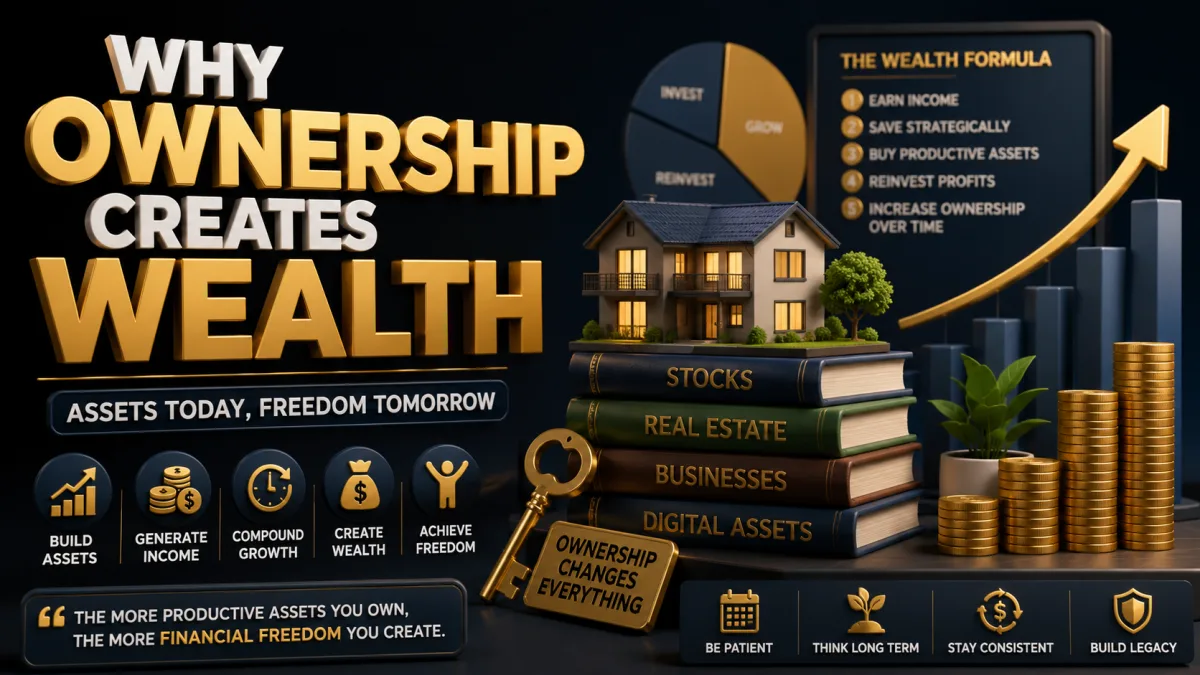
The Simple Wealth Formula
A practical ownership formula can be stated simply: earn income, save strategically, buy productive assets, reinvest profits, and increase ownership over time.
Earn income because income provides the raw material. Save strategically because unspent money becomes capital. Buy productive assets because capital must be placed where it can grow. Reinvest profits because compounding needs fuel. Increase ownership over time because financial freedom expands as productive assets accumulate.
This formula is simple, but not easy. It requires discipline in a culture that encourages constant consumption. It requires patience in markets that reward emotional excitement. It requires humility because not every investment will work. It requires learning because assets are not all equal. It requires resilience because downturns are part of ownership.
Still, the formula has endured because it reflects a timeless financial truth: wealth grows when money is converted into assets that create more money.
Common Mistakes That Delay Ownership
Many people delay wealth building not because they lack intelligence, but because they misunderstand the role of ownership.
The first mistake is focusing only on income. A person may spend years trying to earn more while never learning how to invest. Higher income helps, but without asset accumulation, it can vanish into lifestyle inflation.
The second mistake is waiting too long to begin. Some people believe they need a large sum before investing. In reality, the habit of ownership matters early. Small amounts invested consistently can build knowledge, confidence, and momentum.
The third mistake is confusing speculation with ownership. Buying an asset only because its price recently rose is not the same as understanding what it produces. Speculation depends heavily on someone else paying more later. Ownership focuses on underlying value.
The fourth mistake is overusing debt. Borrowed money can increase returns, but it can also reduce flexibility. A person who uses too much leverage may lose control when conditions change.
The fifth mistake is selling quality assets too soon. Many investors interrupt compounding by reacting to short-term fear, boredom, or excitement. Wealth often belongs to those who can hold sound assets through ordinary volatility.
The sixth mistake is consuming every gain. If every bonus, dividend, business profit, or rent surplus is spent immediately, the ownership base does not grow. Reinvestment is what turns isolated assets into a compounding system.
Ownership and Financial Freedom
Financial freedom does not always mean extreme wealth. For many people, it means having enough assets to make choices without constant financial pressure. It may mean changing careers, starting a business, reducing work hours, helping family, traveling, funding education, retiring with dignity, or simply sleeping better at night.
Ownership supports freedom because assets can produce income and value without requiring the owner to sell every hour. A portfolio can help cover expenses. Rental income can support retirement. Business profits can fund opportunities. Intellectual property can create royalties. Digital assets can produce revenue from past work.
The larger the ownership base, the more options a person has. Options are a form of wealth. The person with assets can wait, negotiate, relocate, invest, decline bad offers, or take calculated risks. The person living paycheck to paycheck often has fewer choices, even with a respectable income.
This is why ownership is transformational. It does not only change a balance sheet. It changes the range of possible decisions.
Teaching the Next Generation to Think Like Owners
One of the most valuable financial lessons a family can teach is the difference between consuming and owning. Children often see spending before they understand investing. They see purchases, gifts, vacations, cars, and homes. They may not see retirement accounts, brokerage statements, business equity, insurance planning, or debt management.
Teaching ownership makes wealth visible in a healthier way. A young person can learn that buying a product and owning part of the company are different experiences. They can learn that a small investment can grow. They can learn that businesses are systems, not mysteries. They can learn that money can be spent once or invested to create future choices.
This lesson should not create fear of spending. It should create respect for capital. Money is a tool. Used only for consumption, it disappears. Used for ownership, it can grow.
Families that teach ownership pass down more than assets. They pass down a way of thinking.
The Long View
Ownership rewards people who can think beyond the next paycheck, the next purchase, and the next market headline. It asks for a longer view. What assets will matter ten years from now? What skills will increase earning power? What investments can compound? What debts should be reduced? What systems can be built? What habits will make ownership automatic?
The long view is not glamorous. It often looks like steady contributions, careful spending, patient holding, boring diversification, reinvested income, and repeated learning. But much of wealth building is less dramatic than people imagine. It is the accumulation of sound decisions.
Over time, the person who consistently buys productive assets changes financial identity. They are no longer only a worker, earner, or consumer. They become an owner. That identity shapes decisions. It influences how raises are used, how risks are evaluated, how opportunities are recognized, and how freedom is pursued.
Final Thought
Income is important, but ownership is transformational. Income pays bills. Ownership builds financial power. Income supports the present. Ownership can shape the future.
The more productive assets a person owns, the more financial leverage that person can create. Stocks, real estate, businesses, digital platforms, intellectual property, and investment funds all offer different paths to the same principle: control assets that produce value.
Ownership does not require perfection. It requires direction. Earn income. Save a portion. Buy productive assets. Reinvest profits. Manage risk. Learn continuously. Hold quality assets long enough for compounding to matter.
Most people work for money. Wealth builders gradually make money work through ownership. That shift is one of the great dividing lines in personal finance, and it remains one of the most reliable paths toward long-term financial strength.

