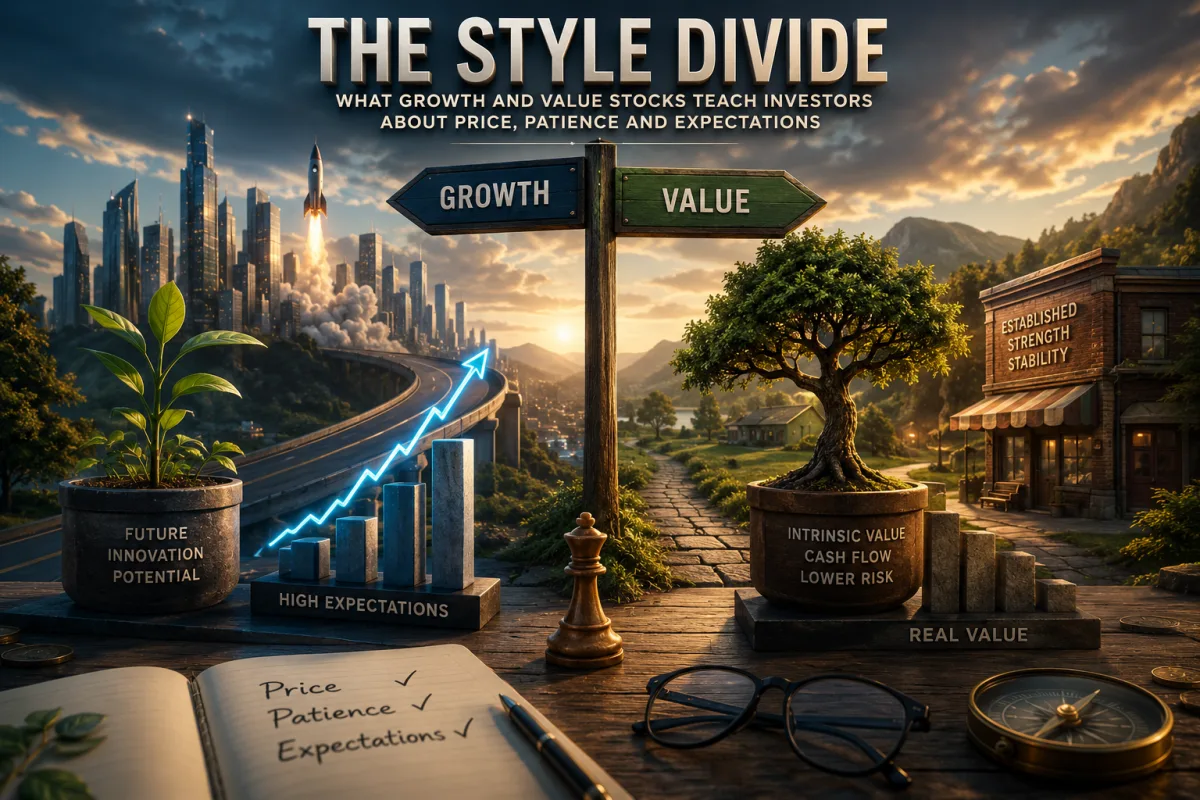
The Style Divide: What Growth and Value Stocks Teach Investors About Price, Patience and Expectations
Every stock investor eventually encounters the same divide: growth versus value.
At first, the distinction appears simple. Growth stocks are companies expected to expand faster than the market. Value stocks are companies that appear inexpensive relative to earnings, assets, cash flow, dividends or other measures of worth. Growth investing seems to ask, “How large can this company become?” Value investing seems to ask, “How much am I paying for what already exists?”
But the real difference is deeper than labels.
Growth and value investing represent two ways of thinking about the future. Growth investors are often willing to pay higher prices today for companies they believe can produce much larger profits tomorrow. Value investors are often unwilling to pay for hope unless the current price already provides a margin of safety. Growth investing rewards vision when the future arrives as expected. Value investing rewards discipline when the market becomes too pessimistic.
Both styles can build wealth. Both can disappoint investors. Both can be misunderstood.
The mistake beginners make is treating growth and value as rival tribes. They hear that growth stocks have outperformed and assume value is outdated. Then they hear that value stocks are rebounding and assume growth was a bubble. They move from one style to another based on recent performance, buying whatever has already done well and abandoning whatever temporarily looks weak. This turns style investing into performance chasing.
A wiser approach is to understand what each style owns, what risks each accepts, what conditions tend to favor each, and how both may fit inside a long-term portfolio.
The question is not whether growth is better than value or value is better than growth. The better question is: what role should each play in the investor’s wealth-building system?
What Growth Stocks Are
Growth stocks are shares of companies expected to increase revenue, earnings, cash flow or market share faster than the average company. These businesses may operate in technology, healthcare, consumer brands, financial platforms, communications, software, clean energy, industrial innovation or other sectors where expansion is expected to be strong.
Growth companies often reinvest heavily. Instead of distributing most profits as dividends, they may spend on research, hiring, infrastructure, marketing, acquisitions or new products. The goal is to expand the business and increase future earnings power.
A strong growth company may have several characteristics. It may serve a large market. It may have a product or service with rising demand. It may enjoy strong customer loyalty, network effects, intellectual property, scale advantages, brand strength or technological leadership. It may be led by management willing to invest aggressively for the future.
Investors buy growth stocks because they believe the company’s future will be much larger than its present. They may accept a high valuation because they expect earnings to catch up over time. The logic is that a company that looks expensive today may prove reasonably priced if profits grow dramatically.
This is the attraction of growth investing. It allows investors to participate in businesses that reshape industries, expand into new markets and compound at high rates for many years.
But growth investing contains a demanding condition: the future must be strong enough to justify the price paid today.
What Value Stocks Are
Value stocks are shares of companies that appear inexpensive relative to some measure of business worth. They may trade at low price-to-earnings ratios, low price-to-book ratios, low price-to-cash-flow ratios, high dividend yields or discounts to estimated intrinsic value.
Value companies are often mature. They may operate in industries such as banking, insurance, energy, utilities, manufacturing, telecommunications, materials, consumer staples or industrials. Some are stable businesses temporarily out of favor. Others are cyclical companies suffering from weak conditions. Some are misunderstood. Some are cheap for good reason.
Value investors buy when they believe the market has become too pessimistic. The company may not be fashionable, but its assets, earnings, dividends or cash flows may be worth more than the current stock price suggests. The investor expects that over time, the market may recognize the value, the business may improve, or the stock may deliver returns through dividends and revaluation.
The classic value principle is margin of safety. The investor does not want to pay full price for optimistic assumptions. They want a discount that protects against error. If the analysis is imperfect, the lower purchase price provides some cushion.
Value investing can be powerful because markets often overreact. Investors become fearful. They abandon unpopular sectors. They extrapolate bad news too far. They sell companies that are temporarily weak but not permanently impaired. A disciplined value investor can benefit when pessimism becomes excessive.
But value investing has its own danger: some cheap stocks are cheap because the business is deteriorating. A low price alone is not enough.
The Real Difference: Expectations
The heart of the growth-versus-value debate is expectations.
A growth stock usually carries high expectations. Investors expect strong future expansion. They may expect rising margins, international growth, product dominance, increasing market share or continued innovation. Because expectations are high, the stock price may already reflect years of success.
This creates risk. If the company performs well but not as well as expected, the stock can fall. A growth stock does not need to fail as a business to disappoint as an investment. It only needs to fall short of what the market already priced in.
A value stock usually carries lower expectations. Investors may expect slow growth, poor sentiment, cyclical pressure or industry challenges. Because expectations are low, the stock may not need spectacular performance to deliver a good return. It may only need conditions to become less bad than feared.
This is why investing is not simply about identifying good companies. It is about comparing future reality with current expectations.
A great company can be a poor investment if bought at too high a price. An ordinary company can be a strong investment if bought at a large enough discount and if the risks are understood. Price and expectation are inseparable.
Growth investors are often betting that the future will be exceptional. Value investors are often betting that the present pessimism is excessive.
Valuation: The Price of the Story
Valuation is where growth and value most visibly differ.
Growth stocks often trade at higher valuation multiples. Investors may pay a high price relative to current earnings because they believe future earnings will be much larger. A company reinvesting heavily may show modest current profits but have strong revenue growth. Another may have high earnings but still trade at a premium because the market expects continued dominance.
Value stocks often trade at lower valuation multiples. Investors may pay less for each dollar of earnings, book value or cash flow because the market doubts the company’s future. The low valuation may reflect cyclical weakness, slow growth, regulatory risk, debt concerns, commodity exposure or lack of excitement.
Valuation does not tell the whole story, but it shapes risk. A high valuation leaves less room for disappointment. A low valuation can provide protection, but only if the business remains viable.
For example, a growth company trading at a very high multiple may need years of strong earnings growth to justify its price. If interest rates rise, competition increases or growth slows, the stock may be revalued downward. A value company trading at a low multiple may already reflect pessimism, but if earnings collapse or the balance sheet weakens, the stock may still be expensive in hindsight.
The investor must understand what the price assumes. In growth investing, the question is: how much future success is already included in the valuation? In value investing, the question is: is the discount real, or is the business permanently impaired?
Growth Investing: The Power and the Pressure
Growth investing can create extraordinary wealth when a company compounds for many years. The most successful growth stocks often begin as businesses with long runways, strong competitive advantages and management teams that reinvest effectively. Their early valuations may look expensive, but growth can eventually make those prices appear reasonable.
The power of growth investing lies in business expansion. A company that can grow revenue, improve margins and reinvest at high returns may increase intrinsic value dramatically. If the market recognizes this progress, shareholders can benefit from both earnings growth and valuation support.
Growth investing also aligns with economic transformation. New technologies, changing consumer behavior, digital platforms, healthcare innovation, logistics improvements and financial infrastructure can create companies that grow far beyond what traditional valuation models first imagine.
But growth investing demands patience and discipline. High-growth companies may experience sharp price declines. Their valuations may be sensitive to interest rates because much of their expected value lies in future cash flows. They may face competition, regulatory pressure, execution risk and changing market narratives.
The emotional pressure is intense. Growth stocks can rise quickly and make investors feel brilliant. They can also fall dramatically when sentiment changes. Investors who buy only after spectacular gains may discover that the market has already priced in perfection.
The disciplined growth investor looks for quality, durable growth, reinvestment opportunity, competitive advantage and reasonable valuation relative to long-term potential. They do not buy every fast-growing company at any price.
Value Investing: The Discipline and the Trap
Value investing appeals to investors who want a margin of safety. It is grounded in the idea that price matters. A business does not need to be glamorous to produce good investment returns if it is purchased cheaply enough.
Value investing can work well when the market becomes too pessimistic. During recessions, sector downturns or temporary crises, investors may sell good companies alongside bad ones. A careful investor can identify businesses whose long-term earning power is stronger than the current price suggests.
Value stocks may also provide dividends. Mature companies with stable cash flows sometimes return capital to shareholders rather than reinvest all profits. For investors seeking income, this can be useful.
But value investing has a famous danger: the value trap.
A value trap is a stock that appears cheap but keeps becoming cheaper because the business is deteriorating. The low valuation is not a market mistake. It is a warning. Revenue may be declining. Debt may be too high. The industry may be shrinking. Management may be poor. Assets may be overstated. Dividends may be unsustainable. Technological disruption may be permanent.
Value investing therefore requires more than buying low multiples. It requires judgment about business quality, balance sheet strength, cash flow durability, industry structure and catalysts for improvement.
The disciplined value investor asks: Why is this stock cheap? What could cause the market to recognize value? What could destroy the thesis? Is the downside protected? Is management allocating capital wisely? Is the dividend safe? Is the balance sheet strong enough to survive stress?
Cheap is not the same as undervalued.
Why Growth and Value Take Turns Leading
Growth and value tend to move in cycles. There are periods when growth dominates and periods when value performs better. These cycles can last years, which makes them emotionally powerful. Investors begin to believe the winning style is permanently superior just as conditions may be shifting.
Growth stocks often perform well when investors prize future expansion, interest rates are low, capital is abundant, technology adoption is strong and earnings growth is scarce in the broader economy. When few companies can grow quickly, the market may pay a premium for those that can.
Value stocks often perform well when valuations matter more, interest rates rise, inflation favors tangible assets or cyclical sectors, economic recovery lifts neglected industries, or investors rotate away from expensive growth expectations. Value may also rebound after long periods of underperformance when pessimism becomes excessive.
Interest rates are especially important. Growth stocks often depend more heavily on future earnings. When rates are low, those future earnings may be valued more highly. When rates rise, future cash flows may be discounted more heavily, pressuring valuations. Value stocks, especially financials, energy or cyclical companies, may sometimes benefit from different economic conditions.
But these relationships are not mechanical. Markets are complex. A growth company with strong cash flow may handle higher rates better than a weak value company. A value stock with too much debt may suffer when rates rise. Style labels are useful, but they do not replace analysis.
The main lesson is that investors should avoid assuming recent leadership will last forever.
The Risk of Performance Chasing
One of the most common mistakes is buying a style after it has already performed well.
When growth stocks outperform for years, investors begin to believe value investing is obsolete. They move money into growth funds, often when valuations are already stretched. When value stocks rebound, investors declare growth overpriced and rotate into value after much of the recovery has occurred.
This behavior turns style investing into a cycle of buying high and selling low.
Performance chasing is emotionally understandable. Investors want to own what is working. They fear being left behind. They compare their portfolios with headlines, friends, social media discussions and recent fund returns. Underperformance becomes painful, even when the long-term plan remains sound.
But investing success usually requires tolerating periods when parts of the portfolio are out of favor. A diversified investor will almost always own something that looks disappointing. That is the cost of not depending on one style, sector or prediction.
The investor should decide on growth and value exposure based on goals, risk tolerance, valuation, diversification and time horizon, not based only on recent returns.
Can a Stock Be Both Growth and Value?
The growth-versus-value distinction is useful, but reality is not always clean. Some stocks can have both growth and value characteristics.
A company may grow steadily while trading at a reasonable valuation. Another may be temporarily undervalued despite strong long-term growth. A mature company may invest in a new business line that changes its growth profile. A former growth company may become a value stock after a sharp decline. A value stock may become a growth stock if a turnaround succeeds.
Investment styles are labels. Businesses are living systems.
This matters because investors should not become trapped by categories. A good investment is not good merely because it is labeled growth or value. It is good because the investor receives attractive future returns relative to the price paid and risk accepted.
The best investors often blend both ways of thinking. They want growth, but not at any price. They want value, but not in dying businesses. They want quality, but not with blind valuation. They want opportunity, but not without risk control.
The deeper lesson is that all investing is ultimately about value. Even growth investors are trying to buy future value. Even value investors need some confidence that the business will remain productive. The difference is where the investor places emphasis.
Quality: The Third Dimension
Growth and value are not the only useful categories. Quality is another important dimension.
A quality company may have strong profitability, durable competitive advantages, reliable cash flow, low debt, good management, high returns on capital and a history of disciplined capital allocation. Quality can appear in both growth and value stocks.
A high-quality growth company may deserve a premium valuation because it can reinvest at attractive rates for years. A high-quality value company may be temporarily mispriced because the market has become too pessimistic. A low-quality growth company may have exciting revenue but no path to sustainable profits. A low-quality value company may look cheap but destroy capital.
Quality helps investors avoid extremes. It reminds growth investors to look beyond sales growth. It reminds value investors to look beyond low multiples.
A business that grows rapidly but cannot generate cash may be fragile. A business that trades cheaply but earns poor returns on capital may remain cheap for years. Quality is the bridge between story and economics.
Dividends and Shareholder Returns
Value stocks are often associated with dividends because mature companies may distribute a portion of profits to shareholders. Dividends can provide income and discipline. They may signal that a company generates real cash. For income-focused investors, dividend-paying stocks can be attractive.
Growth stocks often pay little or no dividends because they reinvest earnings into expansion. This can be sensible if the company can earn high returns on reinvested capital. A dollar retained by a strong growth company may create more long-term value than a dollar paid out as a dividend.
The investor should not assume dividends are always good or always bad. A high dividend may be attractive if it is supported by stable cash flow and a strong balance sheet. It may be dangerous if the company is borrowing to maintain it or paying out money that should be used to strengthen the business.
Similarly, a company that pays no dividend may be wise if it has excellent reinvestment opportunities. It may be wasteful if management keeps cash but invests poorly.
The question is not simply whether a company pays dividends. The question is whether management allocates capital in a way that increases shareholder wealth.
Growth Stocks and Interest Rates
Growth stocks can be sensitive to interest rates because much of their expected value lies in future earnings. When investors value a business, they consider future cash flows. Higher interest rates can reduce the present value of those future cash flows, especially for companies whose profits are expected far into the future.
This is one reason high-growth stocks may struggle when rates rise sharply. If a company’s current earnings are modest but future expectations are high, a higher discount rate can pressure valuation. The stock may fall even if the business continues growing.
Higher rates can also affect funding. Some growth companies rely on external capital to finance expansion. If borrowing becomes more expensive or investor appetite weakens, growth plans may become harder to fund.
But not all growth companies are equally vulnerable. A profitable, cash-rich growth company with strong margins may handle higher rates better than an unprofitable company dependent on new financing. Investors should look beneath the growth label and examine balance sheets, cash flow and business model strength.
Value Stocks and Economic Cycles
Value stocks are often linked to cyclical sectors. Banks, energy companies, industrials, materials and certain consumer businesses may perform better when economic activity improves, inflation supports pricing power or interest rates benefit financial margins.
This can make value investing attractive during economic recoveries. Companies that were priced for poor conditions may rebound as earnings improve. Investors who bought during pessimism may benefit from both higher profits and valuation expansion.
But cyclicality cuts both ways. A company that looks cheap near peak earnings may not be cheap at all. If profits are temporarily inflated by favorable conditions, a low price-to-earnings ratio can mislead investors. When the cycle turns, earnings may fall and the stock may decline.
Value investors must therefore distinguish between normalized earnings and temporary earnings. They should ask whether a company is cheap across a full cycle, not just cheap based on one strong year.
Cyclical value investing requires patience and caution. The best opportunities often appear when conditions are poor but survivable. The worst mistakes often happen when conditions are temporarily excellent and investors assume they will last.
How Growth and Value Fit in a Portfolio
Most long-term investors do not need to choose only one style. A balanced equity portfolio can include both growth and value exposure.
Growth stocks may provide participation in innovation, expanding industries and companies with high reinvestment potential. Value stocks may provide valuation discipline, income, exposure to mature sectors and potential upside when pessimism reverses. Together, they can diversify the sources of equity return.
A broad market index fund usually includes both growth and value companies. This can be enough for many investors. The investor owns the market rather than trying to choose which style will lead next. Others may intentionally tilt toward growth or value based on beliefs, valuation, risk tolerance or long-term strategy.
Tilting requires discipline. If an investor chooses a value tilt, they must be prepared for long periods when growth leads. If they choose a growth tilt, they must be prepared for sharp valuation declines and periods when value outperforms. A tilt should be a long-term decision, not a reaction to recent headlines.
The portfolio should reflect the investor’s goals, not the market’s latest fashion.
Growth and Value for Beginners
Beginners should be careful not to overcomplicate style investing. The first priority is not choosing between growth and value. The first priority is building a diversified, low-cost, long-term investment habit.
A beginner can start with broad funds that hold many companies across styles. This creates exposure to both growth and value without requiring the investor to forecast style cycles. As knowledge grows, the investor may study individual companies, sector funds or style-specific funds. But the core should remain durable.
Beginners should also avoid judging funds only by recent performance. A growth fund that has performed well may carry high valuations. A value fund that has lagged may be positioned for future recovery, or it may hold weak companies. Returns alone do not reveal risk.
The beginner should ask: What does this fund own? What style does it follow? How expensive is it? How volatile has it been? How does it fit with my other investments? Am I buying because it fits my plan or because it recently did well?
Style awareness is useful. Style obsession is not.
Growth and Value for Retirees
Retirees often need a different balance. They may require income, capital preservation and inflation protection. Value stocks, dividend-paying companies and fixed income may play important roles. But retirees should not automatically avoid growth.
Retirement can last decades. Inflation can erode purchasing power. Some growth exposure may help a portfolio continue expanding over time. The challenge is balancing growth with stability and withdrawal needs.
A retiree who depends on portfolio withdrawals cannot tolerate the same risk as a young investor with decades of contributions ahead. But a portfolio that is too conservative may fail to keep up with inflation. The balance depends on spending needs, pension income, cash reserves, health, family obligations and total assets.
Growth and value are not only about return. They are tools for shaping income, volatility and long-term purchasing power.
Growth and Value for Business Owners
Business owners often have significant growth exposure already, even if they do not realize it. Their company may be the largest asset in their financial life. It may depend on economic expansion, customer demand, reinvestment and future profitability. In that sense, their personal wealth may already be tied to a growth story.
This matters when building an investment portfolio. A business owner may benefit from diversifying into liquid assets, fixed income, dividend-paying stocks or value-oriented funds to reduce dependence on the business. On the other hand, if the business is mature and stable, the owner may use public markets to gain exposure to faster-growing industries.
The right mix depends on the total balance sheet. Investors should not view their stock portfolio in isolation. Their job, business, property, debt, currency exposure and family obligations all affect appropriate investment risk.
For business owners, growth versus value should be considered alongside concentration risk.
Common Mistakes Investors Make
The first mistake is assuming growth stocks are always better because they sound more exciting. A fast-growing company can be a poor investment if the price is too high or the growth proves temporary.
The second mistake is assuming value stocks are always safer because they look cheap. Cheap stocks can become cheaper if the business deteriorates.
The third mistake is switching styles based on recent returns. Investors who chase performance often buy after a style has already enjoyed strong gains.
The fourth mistake is ignoring quality. Growth without profitability can be fragile. Value without business strength can become a trap.
The fifth mistake is concentrating too heavily in one style without understanding the emotional cost. A portfolio tilted strongly toward growth or value may underperform for years. The investor must be prepared.
The sixth mistake is using labels instead of analysis. A fund called growth may hold expensive mature companies. A fund called value may hold troubled businesses. The investor must look at what is actually owned.
How to Analyze a Growth Stock
A growth stock should be analyzed through several questions.
How large is the market opportunity? Is demand expanding? Does the company have a durable advantage? Are customers loyal? Can competitors copy the product easily? Are margins improving or under pressure? Is revenue growth translating into cash flow? Is management allocating capital wisely? How much debt does the company carry? Is the valuation reasonable under conservative growth assumptions?
The investor should also ask what could go wrong. Could growth slow? Could regulation increase? Could a larger competitor enter? Could customer acquisition costs rise? Could technology change? Could management overexpand? Could the stock fall sharply if expectations are missed?
Growth investing requires imagination, but imagination must be tested against economics.
How to Analyze a Value Stock
A value stock should also be analyzed carefully.
Why is the stock cheap? Is the problem temporary or permanent? Is the balance sheet strong enough to survive stress? Are cash flows stable? Are earnings cyclical? Is management competent? Does the company have assets that are undervalued? Is the dividend sustainable? What could cause the market to revalue the stock? What could cause further decline?
The investor should avoid relying on one low valuation ratio. A low price-to-earnings ratio may be misleading if earnings are about to fall. A low price-to-book ratio may be misleading if assets are overstated. A high dividend yield may be misleading if the dividend is about to be cut.
Value investing requires skepticism. The investor must prove that the market is wrong, not merely notice that the price is low.
The Role of Funds
Many investors access growth and value through mutual funds, exchange-traded funds or retirement account options. This can reduce company-specific risk and simplify portfolio construction.
A growth fund may hold companies with above-average expected earnings growth. A value fund may hold companies trading at lower valuation multiples. A blend fund may hold both. A broad market fund may provide exposure to the full market.
When evaluating style funds, investors should examine costs, holdings, concentration, turnover, manager process, index methodology, tax implications and historical behavior. A low-cost index fund may provide transparent exposure. An active fund may justify higher fees only if the manager has a clear, disciplined process and a reasonable chance of adding value after costs.
Funds make style exposure easier, but they do not remove the need for understanding.
Building a Sensible Growth and Value Strategy
A sensible strategy begins with the core portfolio.
For many investors, the core can be a broad diversified equity fund that includes both growth and value companies. This reduces the need to predict which style will lead. Around that core, the investor may add a modest tilt toward growth, value, quality or dividends if it fits their beliefs and goals.
The investor should define the tilt in advance. For example, they may decide that 70 percent of equity exposure will remain broad market, while 15 percent tilts toward growth and 15 percent toward value. Another investor may choose a stronger value tilt for valuation reasons or a stronger growth tilt because of time horizon and risk tolerance.
The key is to avoid emotional changes. A strategy should not be abandoned simply because one style underperforms for a few years. Style cycles are normal. The investor should rebalance periodically rather than chase whichever side is currently leading.
Discipline matters more than the exact split.
The Deeper Lesson
Growth and value investing teach opposite but complementary lessons.
Growth investing teaches that exceptional businesses can become far more valuable over time. It reminds investors not to underestimate innovation, reinvestment and the power of compounding within a company.
Value investing teaches that price matters. It reminds investors that optimism can become excessive and that even good stories can become bad investments if purchased without discipline.
Together, they teach the complete investing lesson: own productive assets, but do not ignore what you pay for them.
An investor who only studies growth may become too willing to pay for possibility. An investor who only studies value may miss businesses that deserve premium valuations because they can compound for years. The best investment thinking respects both future potential and present price.
Final Thoughts
Growth versus value is one of the most important distinctions in stock investing, but it should not become a rigid identity.
Growth stocks offer exposure to companies expected to expand faster than the market. Value stocks offer exposure to companies priced below what investors believe they are worth. Growth carries the risk of excessive expectations. Value carries the risk of cheapness that reflects real decline. Growth can build wealth through expansion. Value can build wealth through revaluation, income and disciplined purchase prices.
Both styles have a place. Both move in cycles. Both require analysis. Both can disappoint investors who buy without understanding risk.
The long-term investor should not ask which style is fashionable. The investor should ask what they own, what they paid, what future assumptions are required, how the investment fits the portfolio and whether they can hold through periods of underperformance.
Growth teaches investors to respect the future. Value teaches investors to respect the price. Wealth is built when both lessons are understood.

