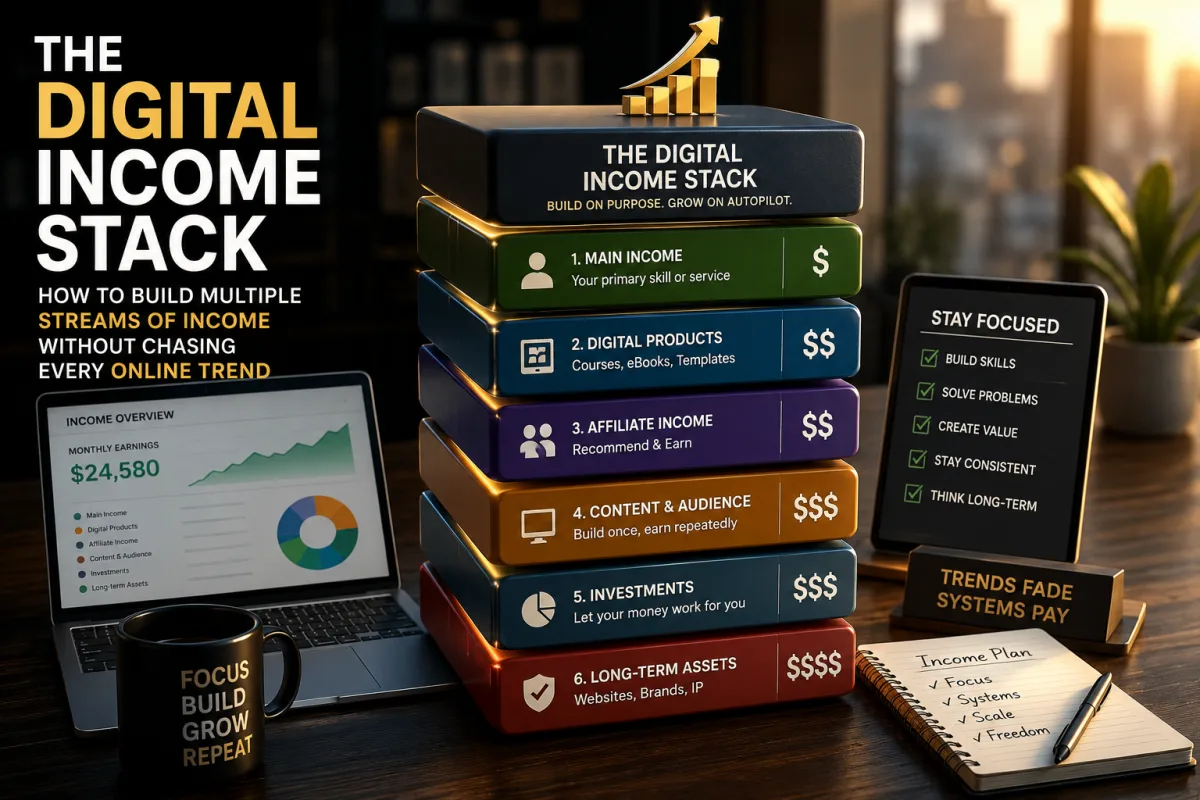
The Digital Income Stack: How to Build Multiple Streams of Income Without Chasing Every Online Trend
The digital age has changed what income can look like.
A person no longer has to rely only on one employer, one shopfront, one local market, one professional title or one physical location to earn money. A designer can sell templates globally. A teacher can create an online course. A writer can build a newsletter. A consultant can serve clients across borders. A programmer can build software. A photographer can license images. An investor can own shares through digital platforms. A small business can sell products without renting a traditional storefront.
This does not mean making money has become easy. It means access has changed.
The internet has lowered many barriers, but it has not removed the basic laws of income. Money still flows toward value. People pay because a product saves time, solves a problem, improves status, reduces pain, creates convenience, teaches a skill, entertains, protects, organizes, inspires or produces a result. A digital income stream that creates no value will not last simply because it is online.
The digital age has also created a new kind of financial temptation. Because anyone can publish success stories, the internet is full of screenshots, claims, launches, side hustles, passive income promises and income reports that make wealth look instant. A beginner sees someone selling courses, affiliate products, software, templates, coaching, newsletters, digital downloads, YouTube channels, e-books, stock photos, print-on-demand products and subscription communities, then assumes the goal is to build everything at once.
That is usually a mistake.
Multiple income streams should be built like a portfolio, not collected like distractions. The goal is not to chase every trend. The goal is to create a few strong income engines that fit your skills, assets, audience, capital, risk tolerance and time. A scattered person may have ten unfinished projects and little income. A focused person may build one valuable skill, turn it into a service, productize the service, create educational content, invest the profits and eventually own several income streams that reinforce one another.
Digital income is powerful when it is built with sequence.
First, build a valuable skill. Then earn from that skill. Then systemize delivery. Then turn knowledge into assets. Then build distribution. Then reinvest income into financial assets. Then protect the whole system from platform risk, tax problems, burnout and overdependence on one source.
Multiple streams of income are not only about earning more money. They are about resilience. A person with one paycheck is vulnerable to one employer. A freelancer with one client is vulnerable to one relationship. A creator with one platform is vulnerable to one algorithm. A business with one product is vulnerable to one market shift. A family with one income source may face crisis when that income stops.
Digital income streams can reduce that vulnerability, but only if they are built intelligently.
What Multiple Income Streams Actually Mean
Multiple income streams are different sources of money flowing into a person, household or business.
They may include salary, freelance income, consulting fees, digital product sales, course revenue, affiliate commissions, advertising income, dividends, interest, rental income, royalties, software subscriptions, membership fees, e-commerce profit, licensing fees or business distributions.
The purpose is not merely to have many streams. The purpose is to reduce dependence and increase wealth-building capacity. A second income stream can pay down debt faster. A third can fund investments. A fourth can build emergency reserves. A fifth can create flexibility to change careers or reduce working hours. Over time, income from ownership can reduce dependence on income from labor.
But not all income streams are equal.
Some streams are active. They require direct work for every payment. Freelancing, consulting, coaching, employment and client services usually fall here. They can be excellent because they generate cash quickly, but they depend on time and availability.
Some streams are semi-passive. They require upfront work and ongoing maintenance, but not direct hourly delivery for every sale. Digital products, online courses, content websites, YouTube channels, newsletters, templates and affiliate content often fall here.
Some streams are asset-based. They require capital, ownership or rights. Dividends, interest, rental income, royalties, business equity and investment distributions fall here. They can become more passive, but they usually require either money, skill, risk or years of accumulation.
A strong income strategy often moves through all three stages. Active income creates cash. Semi-passive income creates leverage. Asset income creates long-term wealth.
The Biggest Mistake: Starting Too Many Things at Once
The digital world rewards attention, but wealth rewards focus.
A person may hear about freelancing on Monday, affiliate marketing on Tuesday, dropshipping on Wednesday, YouTube on Thursday, crypto trading on Friday, online courses on Saturday and artificial intelligence tools on Sunday. By the end of the week, they have started seven projects and finished none.
This is the trap of digital opportunity. The more options exist, the easier it becomes to confuse movement with progress.
Every income stream has a learning curve. Freelancing requires skill, positioning, proposals, pricing and client delivery. Content creation requires consistency, audience understanding and distribution. Digital products require problem selection, product creation, sales pages and marketing. Software requires development, support and retention. Investing requires education, risk management and patience.
Trying to learn all of them at once weakens execution.
The better approach is to build income streams sequentially. Start with the stream closest to your current advantage. If you already have a marketable skill, sell a service first. If you already have an audience, create a product or affiliate offer. If you already have capital, build an investment portfolio. If you already have knowledge people need, teach or consult. If you already have a business, create digital extensions of that business.
Do not begin with the idea that sounds most exciting. Begin with the idea where you can create value fastest.
Start With Skill-Based Income
The first digital income stream for many people should be skill-based.
This is because skill-based income usually requires less capital than asset-based income. You do not need to buy property, build a factory or raise venture capital to begin. You need a valuable skill, a clear market and the ability to deliver a result.
Digital skills can include writing, editing, bookkeeping, graphic design, web development, social media management, paid advertising, data analysis, virtual assistance, video editing, translation, tutoring, coding, email marketing, search optimization, customer support, automation, project management, financial modeling, presentation design, online research or consulting.
The best skill is not necessarily the one you enjoy most. It is the overlap between what you can do well, what people need and what they are willing to pay for.
Skill-based income is powerful because it can create cash flow quickly. A person can offer services to businesses, creators, professionals, schools, startups, nonprofits or individuals. The income can then fund emergency savings, debt repayment, investments, tools, training or product development.
The limitation is that service income is usually tied to time. If you stop working, the income often stops. That is not a failure. It is the first layer. The goal is to use skill-based income as the foundation for more leveraged streams later.
Freelancing: The Fastest Digital Bridge From Skill to Cash
Freelancing is one of the most direct ways to create a second income stream in the digital age.
A freelancer sells a service to clients without being a full-time employee. The service may be delivered remotely, locally or both. The advantage is speed. If you can solve a problem, you can begin earning before building a large audience or product.
The key to freelancing is specificity. “I can help with marketing” is vague. “I write weekly email newsletters for financial advisers” is clearer. “I design pitch decks for early-stage startups” is clearer. “I edit short-form videos for fitness coaches” is clearer. Specificity makes it easier for clients to understand why they should hire you.
Freelancers often undercharge because they price based on time rather than value. In the beginning, hourly pricing may be necessary. Over time, better freelancers learn to price projects based on outcomes, expertise and market demand.
Freelancing becomes a wealth-building tool when income is not fully consumed. A portion should be reserved for taxes, a portion for business expenses, a portion for savings and a portion for investments. Otherwise, freelancing can become a second job with no lasting financial improvement.
The long-term opportunity is to productize. Once you repeatedly deliver the same service, you can create packages, templates, systems, retainers or digital products that reduce custom work.
Consulting: Selling Judgment, Not Just Time
Consulting is similar to freelancing, but it usually sells expertise, diagnosis and strategy rather than execution alone.
A consultant helps clients make better decisions. This may include business strategy, finance, operations, marketing, technology, human resources, compliance, sales, branding, data, productivity, career growth or industry-specific advice.
Consulting can produce strong income because clients pay for clarity, not only labor. A good consultant can help a business avoid costly mistakes, increase revenue, improve systems, reduce waste or execute a plan more effectively.
The challenge is credibility. Clients need to believe that your advice is worth paying for. Credibility may come from professional experience, case studies, results, credentials, reputation, content, referrals or deep specialization.
Digital consulting can be delivered through video calls, audits, reports, workshops, retainers, advisory packages or strategy sessions. It can also lead to other income streams such as courses, books, templates, memberships, software or paid communities.
The smart path is to document repeated client problems. If many clients ask the same questions, that may become a product. If many need the same tool, that may become a template. If many need the same training, that may become a course. Consulting can reveal market demand before you build scalable assets.
Online Coaching and Tutoring
Coaching and tutoring can turn knowledge into digital income.
Tutoring usually focuses on teaching a defined subject or skill. This may include languages, exams, mathematics, coding, finance, music, writing, business skills or professional certifications. Coaching often focuses on guidance, accountability and transformation in areas such as career, leadership, fitness, personal finance, productivity, sales or entrepreneurship.
The digital advantage is reach. A tutor or coach can serve clients beyond their local area using video calls, learning platforms, messaging tools and digital resources.
The risk is that coaching markets can become crowded and poorly regulated. Trust matters. A coach should avoid making promises they cannot support. The strongest offers are grounded in real competence, clear outcomes and ethical practice.
Coaching can also become more scalable over time. One-on-one sessions can become group programs. Group programs can become courses. Course material can become workbooks, templates or membership resources. The income stream can move from active to semi-passive if systems are built.
The beginner should start with a clear promise: who is helped, what problem is solved, what outcome is realistic and what process will be used.
Digital Products: Turning Knowledge Into Assets
Digital products are one of the most attractive income streams because they can be sold repeatedly after creation.
Examples include e-books, templates, spreadsheets, calculators, planners, design assets, stock photos, Notion dashboards, budget trackers, business forms, study guides, scripts, swipe files, software presets, printable worksheets, meal plans, workout plans, financial models and professional toolkits.
The advantage is scalability. Selling one copy or one thousand copies may not require much additional production cost. This can create high margins if the product solves a real problem.
The challenge is demand. Many people create products they want to make rather than products buyers want to buy. A successful digital product solves a specific problem for a specific person. It saves time, reduces confusion, improves results or helps the buyer move faster.
Before building a digital product, listen to repeated questions. What do people ask you to explain? What do clients need again and again? What spreadsheet do you use that others would value? What process have you simplified? What document could save someone hours?
Digital products become stronger when attached to distribution. A product without traffic rarely sells. Distribution may come from content, email lists, social media, partnerships, marketplaces, search engines, affiliates or existing clients.
A digital product is not passive at the beginning. Creation, positioning, marketing, customer support and updates all require work. But once built and marketed well, it can become a meaningful semi-passive stream.
Online Courses: Teaching at Scale
Online courses can turn expertise into structured education.
A course may teach a technical skill, professional process, academic subject, software tool, business method, creative practice, financial habit or career outcome. The buyer pays because the course promises to shorten the learning curve.
The strongest courses are not broad information dumps. They are organized transformations. The student begins with a problem and ends with a result. A course titled “Marketing” is vague. A course that teaches small business owners how to build their first email sales funnel is clearer. A course titled “Investing” is broad. A course teaching beginners how to create their first diversified portfolio is more useful.
Online courses require planning. The creator must understand the learner’s starting point, desired outcome, obstacles, examples, exercises, support needs and success measures. Video quality matters, but clarity matters more. A beautifully produced course that does not solve a problem will struggle.
Marketing is often harder than creation. Many people build courses before building trust or audience. A better path is to teach publicly first through articles, videos, newsletters, webinars or workshops. Audience response reveals what people want to learn.
Courses can become long-term income assets if they remain relevant, receive updates and have reliable distribution.
Content Creation: Building an Audience Asset
Content creation can become an income stream because attention can be monetized.
Content may include articles, newsletters, podcasts, videos, social media posts, webinars, guides, reports, tutorials or livestreams. The income can come from advertising, sponsorships, affiliate marketing, digital products, courses, memberships, consulting leads, speaking, book sales or business opportunities.
The mistake is thinking content itself is the business. Content is often the distribution system. It attracts trust and attention. The business model sits behind it.
For content to build income, it should serve a defined audience. Who is it for? What problem does it solve? Why should they return? What result do they get from consuming it?
Evergreen content is especially valuable. A useful article or video can attract readers or viewers for months or years if it answers a recurring question. Trend-based content may spike quickly and disappear quickly. A strong content strategy often includes both timely relevance and timeless education.
Content creation is not easy. It requires consistency, taste, analysis, editing, distribution and patience. But over time, a library of useful content can become a powerful income-generating asset.
Newsletters and Email Lists
An email list is one of the most valuable digital assets because it gives direct access to an audience.
Social platforms can change algorithms. Search rankings can shift. Accounts can be restricted. But an email list creates a more direct relationship with readers, customers or clients.
A newsletter can generate income through sponsorships, paid subscriptions, affiliate offers, digital products, courses, consulting, events, community membership or product launches. It can also strengthen trust by showing up consistently with useful insight.
The best newsletters are not random updates. They deliver a clear promise. A reader subscribes because they expect useful financial lessons, market analysis, career opportunities, business ideas, health research, local events, investment education or another defined value.
Building an email list takes time. The creator needs a reason for people to subscribe. This may be a free guide, calculator, checklist, template, mini-course or simply consistently excellent writing.
A newsletter becomes an income stream when trust, relevance and offers align. If every email is a sales pitch, readers leave. If no offer is ever made, income may not develop. Balance matters.
Affiliate Marketing
Affiliate marketing pays commissions when someone purchases through your referral.
This can work well when attached to useful content. A financial educator may recommend budgeting tools. A software reviewer may compare business platforms. A travel writer may recommend luggage or booking services. A creator may recommend books, courses, tools or products they genuinely use.
The strength of affiliate marketing is leverage. A well-written review or tutorial can continue generating commissions if it receives traffic and remains relevant.
The risk is trust erosion. If recommendations are based only on commission size, the audience eventually notices. Ethical affiliate marketing requires transparency and alignment. Recommend products that genuinely help the audience. Disclose relationships where required. Do not promote products you do not understand.
Affiliate income is also vulnerable to program changes. Companies can reduce commissions, change terms, close programs or alter tracking. This is why affiliate marketing should usually be one income stream, not the only one.
Affiliate marketing works best when it serves the audience first and monetizes second.
Advertising Income
Advertising income comes from placing ads on content platforms such as websites, YouTube channels, podcasts, apps or newsletters.
The advantage is that revenue can be generated from attention without directly selling a product to every viewer or reader. If traffic is large and advertiser demand is strong, advertising can become meaningful.
The limitation is that advertising often requires scale. Small audiences may produce small income. Ad rates can fluctuate by niche, geography, season and economic conditions. Platforms may change policies or algorithms. Content may be demonetized. Advertisers may reduce budgets.
Advertising works best when combined with other income streams. A website might earn ad income while also selling products and affiliate recommendations. A YouTube channel might earn ads while also promoting courses, sponsorships and consulting. A podcast might use ads alongside memberships or events.
Advertising can be passive once content is published, but the underlying audience engine requires ongoing work.
Paid Communities and Memberships
Paid communities and memberships create recurring income by offering ongoing value.
Members may pay for education, accountability, networking, resources, expert access, research, templates, group coaching, exclusive content, deal flow or support. The appeal is recurring revenue. Instead of selling once, the business earns as long as members stay.
The challenge is retention. People cancel when value declines, attention fades or money becomes tight. A membership must keep solving an ongoing problem.
Strong communities usually have clear positioning. They are not “for everyone interested in business.” They may be for freelance designers trying to reach six-figure revenue, early-stage investors studying African markets, parents teaching children financial literacy, or small business owners improving cash flow.
Community management is work. Members need engagement, moderation, programming and trust. A neglected community becomes quiet quickly.
Memberships can become powerful income streams when they combine recurring value, strong leadership and a specific audience need.
Software and Digital Tools
Software can create highly scalable income when it solves a repeated problem.
A software product may be a mobile app, web application, plugin, calculator, automation tool, workflow system, budgeting platform, scheduling tool, analytics dashboard, niche business tool or productivity product. Customers may pay once, subscribe monthly or pay based on usage.
The attraction is leverage. Software can serve many users without custom delivery for each one. Subscription software can create recurring revenue.
The challenge is that software is not passive. It requires development, hosting, security, updates, bug fixes, customer support, user onboarding, payment processing and marketing. A broken or insecure product can damage trust quickly.
The best software products solve narrow, painful problems. A small tool that saves a business three hours per week may be more valuable than a broad app with no clear user.
Non-technical founders can still build software, but they need strong product thinking, customer understanding and reliable technical partners. Technical founders still need distribution and business judgment.
Software can become a major income stream, but it should be treated like a real business, not an overnight passive asset.
E-Commerce and Digital Storefronts
E-commerce allows people to sell physical or digital products through online storefronts.
This may include handmade goods, branded products, print-on-demand merchandise, books, templates, specialty foods, beauty products, clothing, educational materials, home goods, electronics accessories or niche products. The digital advantage is reach, convenience and lower overhead compared with some traditional retail models.
But e-commerce is not automatically profitable. Product sourcing, inventory, shipping, returns, customer service, payment processing, advertising, packaging, taxes and competition all affect margins. A store can generate impressive sales and still produce little profit.
The best e-commerce businesses understand the customer deeply. They do not merely list products. They build trust, solve a specific need, create a brand, manage operations and control customer acquisition costs.
Digital storefronts are strongest when paired with content, email lists, communities or unique product positioning. Competing only on price can become difficult.
E-commerce can create income, but it is a business with logistics, not simply a website with products.
Print-on-Demand
Print-on-demand allows creators to sell products such as shirts, mugs, posters, notebooks, phone cases or home goods without holding inventory.
When a customer orders, a third-party provider prints and ships the item. This reduces upfront inventory risk and makes it easier to test ideas.
The appeal is simplicity. The seller can focus on design, niche selection and marketing. The limitation is lower margins, quality control dependence and heavy competition. Generic designs rarely sell well because many people can create them.
Print-on-demand works best when tied to a specific audience, identity, community, inside joke, profession, hobby, cause or brand. A design for “everyone” usually reaches no one. A design for nurses who love marathon running, software developers with a specific humor style, or fans of a niche hobby may be more effective.
This income stream can become semi-passive after designs and listings are created, but marketing and product testing remain important.
Licensing and Royalties
Licensing allows creators to earn income from intellectual property.
Music, photography, illustrations, fonts, patterns, designs, software code, books, educational material, research, patents, trademarks or media assets can be licensed to others for use. Royalties may be paid per sale, per use, per period or through negotiated agreements.
This is one of the more asset-like digital income streams because the creator earns from rights, not only labor. But it requires creating work that others value and establishing distribution or licensing relationships.
A photographer may upload images to stock platforms. A musician may license tracks for videos. A designer may sell font licenses. A writer may license content. A software developer may license code. An educator may license curriculum.
The important issue is rights management. Understand what is being sold, what rights remain yours, whether the license is exclusive, how payments are calculated and whether the buyer can resell or modify the work.
Licensing can create long-term income when a catalog of useful assets is built over time.
Investing as an Income Stream
Digital platforms have made investing more accessible, but investing should not be confused with online gambling.
Investment income may come from dividends, interest, bond coupons, money market funds, real estate investment trusts, investment funds, rental platforms, business equity or capital gains. Unlike freelancing or content creation, investing usually requires capital. The more capital invested wisely, the more meaningful the income can become.
For most people, investing should be built from surplus generated by active income. Salary, freelancing, consulting, business profit or digital product sales can fund investment accounts. Over time, investment income becomes another stream.
The advantage of investment income is that it comes from ownership. The limitation is that it takes time and capital to become significant. A small portfolio may produce small dividends or interest. That is normal. Reinvestment can help it grow.
Investors should understand risk, fees, taxes, diversification, time horizon and liquidity. Digital access makes investing easier, but easy access can also encourage impulsive trading. A serious investor needs a plan.
Income from assets is the long-term destination of multiple income streams. Active income funds ownership. Ownership funds freedom.
Turning One Stream Into Several
The smartest digital income strategy often begins with one stream and expands naturally.
Consider a financial analyst. First, they freelance by building budget models for small businesses. Then they notice clients ask similar questions, so they create a cash-flow template. Then they write articles explaining business budgeting. The articles attract an email list. The email list sells the template. Later, they launch a course on small business finance. Then they offer group consulting. Profits from all of this are invested into index funds and bonds.
This is an income stack. Each layer supports the next.
Or consider a fitness coach. They begin with one-on-one online coaching. Then they create a beginner workout plan. Then they publish videos. Then they sell a membership. Then they license meal plans. Then they invest profits.
The pattern is similar: skill, service, content, product, community, assets.
This is more powerful than random diversification. The streams share a theme, audience and expertise. Marketing one stream helps the others. Experience from one layer improves the next.
Multiple income streams should compound attention, not divide it.
The Role of Personal Brand
In the digital age, trust is a financial asset.
A personal brand is not merely a logo or social media profile. It is the reputation attached to your name, expertise, values and results. People buy services, courses, templates, consulting, books and memberships from people they trust.
A strong personal brand can lower customer acquisition costs. Instead of constantly chasing strangers, you attract people who already understand your value. It can also create opportunities that are difficult to plan: partnerships, speaking, consulting, media, jobs, collaborations and investment access.
Building a personal brand requires consistency and credibility. Share useful ideas. Demonstrate competence. Tell the truth. Avoid exaggerated claims. Show your work. Serve a specific audience. Over time, reputation compounds.
The risk is becoming addicted to visibility without building a business model. Attention alone does not pay unless it is connected to offers, services, products or opportunities.
Personal brand is most powerful when it supports real value creation.
Platform Risk
Digital income often depends on platforms, and platforms can change.
A creator may depend on YouTube, TikTok, Instagram, Google, Amazon, Etsy, Shopify, Upwork, Fiverr, Substack, Patreon, app stores, payment processors or advertising networks. These platforms provide access, but they also create risk.
Algorithms change. Accounts can be suspended. Fees can rise. Rules can shift. Search rankings can fall. Marketplaces can become crowded. A platform may favor different content or products. A payment provider may freeze funds.
This does not mean platforms should be avoided. They are useful. But a smart income strategy reduces dependence. Build an email list. Own a website. Keep customer records where legally allowed. Diversify traffic sources. Develop direct relationships. Maintain multiple payment options if possible. Save cash reserves.
Platform income can be powerful, but ownership of audience and customer relationships creates resilience.
Tax and Record-Keeping Discipline
Multiple income streams create tax complexity.
A person earning from freelancing, consulting, courses, affiliate marketing, investments, e-commerce and royalties must understand what taxes apply. Different income types may have different rules. Business expenses may be deductible in some cases. Sales taxes, value-added taxes, withholding taxes, income taxes, payroll taxes or platform reporting may apply depending on jurisdiction.
The worst habit is treating gross income as spendable income. A freelancer who receives $1,000 has not necessarily earned $1,000 of personal spending money. Some may belong to taxes, software costs, subcontractors, platform fees, refunds, equipment, savings and investment.
Keep separate accounts where possible. Track revenue and expenses. Save receipts. Set aside tax money as income arrives. Understand filing dates. Use accounting tools or professional help when needed.
Multiple income streams are supposed to create freedom. Poor records can turn them into stress.
Protecting Your Time and Energy
Multiple income streams can become multiple forms of burnout.
The digital age creates pressure to always be building, posting, launching, optimizing, replying, updating, learning and selling. Without boundaries, a side income can consume evenings, weekends, sleep, health and relationships.
A good income stream should improve life, not destroy it. This means measuring income against time, stress and opportunity cost. A stream earning money but consuming all attention may not be worth it if it blocks higher-value work or damages health.
Systemization matters. Use templates, automation, standard operating procedures, scheduling, batching, outsourcing, clear offers and repeatable processes. Avoid custom complexity unless it is priced appropriately.
Digital income should become more efficient over time. If every dollar requires more exhaustion, the model needs review.
How to Choose Your First Digital Income Stream
To choose your first stream, begin with your current assets.
What skills do you already have? What problems can you solve? What tools do you know? What industry experience do you carry? What questions do people ask you? What audience do you understand? What capital can you risk? How much time can you commit? How quickly do you need income?
If you need income quickly, start with services. Freelancing, tutoring, consulting, editing, virtual assistance, design, bookkeeping, social media support or project work can produce cash faster than building an audience from zero.
If you have expertise but limited time, consider templates, guides, workshops or digital products based on repeated problems.
If you have an audience, consider newsletters, affiliate marketing, courses, memberships or sponsorships.
If you have capital, consider diversified investing while also building active income.
If you have technical ability, consider software, automation tools or niche digital products.
The best first stream is one that can realistically produce value and income within your current constraints.
A Practical 12-Month Digital Income Roadmap
In the first month, audit your skills, income, expenses and available time. Choose one income stream to focus on. Do not choose five.
In the second month, define a specific offer. Identify who you help, what problem you solve and what result you provide. Create a simple portfolio, landing page or profile.
In the third month, seek your first paid customer, client or sale. The goal is proof, not perfection.
In months four to six, improve delivery. Collect testimonials, refine pricing, document processes and understand recurring customer needs. Save part of the income rather than spending it all.
In months seven to nine, productize. Turn repeated work into packages, templates, guides, workshops or systems. Begin building an email list or owned audience.
In months ten to twelve, add leverage carefully. This may mean a digital product, affiliate partnership, small course, content library, newsletter, subcontractor or investment contribution funded by income.
At the end of the year, review honestly. Which stream produced income? Which drained energy? What can be systemized? What should be stopped? What should be scaled?
A year of focused execution can produce more than years of scattered experimentation.
Common Mistakes to Avoid
The first mistake is chasing every trend. Digital wealth is built through focus, not constant switching.
The second mistake is building before validating demand. Do not spend months creating a product no one wants.
The third mistake is confusing audience size with income. A small trusted audience can be more valuable than a large unengaged one.
The fourth mistake is underpricing services. Cheap pricing can attract difficult clients and create exhaustion.
The fifth mistake is ignoring taxes. Multiple income streams require disciplined records and reserves.
The sixth mistake is depending on one platform. Build owned channels and direct relationships.
The seventh mistake is calling active work passive income. Be honest about the effort required.
The eighth mistake is spending all extra income. Additional income should build assets, not only lifestyle.
The ninth mistake is neglecting contracts. Freelancers, consultants, creators and partners need clear terms.
The tenth mistake is quitting a main income too early. A side stream should be stable enough before it replaces essential income.
How Digital Income Builds Long-Term Wealth
Digital income becomes powerful when it is connected to wealth building.
The first purpose is stability. Extra income can build emergency savings and reduce dependence on debt.
The second purpose is acceleration. Extra income can pay down loans, fund investments, buy equipment, purchase education or support a business.
The third purpose is ownership. Income from services can buy assets. Income from products can fund portfolios. Income from content can build a business. Income from a business can buy property, funds, bonds or other assets.
The fourth purpose is freedom. As investments and business systems grow, the person becomes less dependent on one paycheck or one client. They gain options.
This is the right sequence: active income, surplus, assets, compounding, freedom.
Digital income that is immediately consumed may improve lifestyle but may not build wealth. Digital income that is invested can change the long-term financial trajectory.
Final Thoughts
The digital age has created more ways to earn, but it has not changed the foundation of wealth.
Money still follows value. Wealth still requires surplus. Assets still matter. Trust still matters. Risk still exists. Taxes still apply. Time and focus still separate serious builders from distracted dreamers.
Creating multiple income streams does not mean doing everything at once. It means building a thoughtful income stack. Start with a skill. Turn that skill into income. Use the income to build stability. Productize repeated knowledge. Build an audience or distribution channel. Add scalable offers. Invest the surplus into long-term assets. Protect the system from platform risk, tax problems, burnout and overdependence.
Some digital income streams will remain active. That is acceptable if they pay well and build skills. Some will become semi-passive. Some will become assets. The goal is not to make every dollar effortless. The goal is to make your financial life stronger, more diversified and less dependent on a single source.
A digital income strategy should not be judged by how exciting it sounds. It should be judged by whether it creates real value, produces profit, fits your life, strengthens your balance sheet and can survive change.
The opportunity is real. So is the discipline required.
Build one stream well. Let it fund the next. Reinvest before lifestyle absorbs everything. Over time, multiple streams of income can become more than a side hustle collection. They can become the architecture of financial resilience and long-term wealth.

