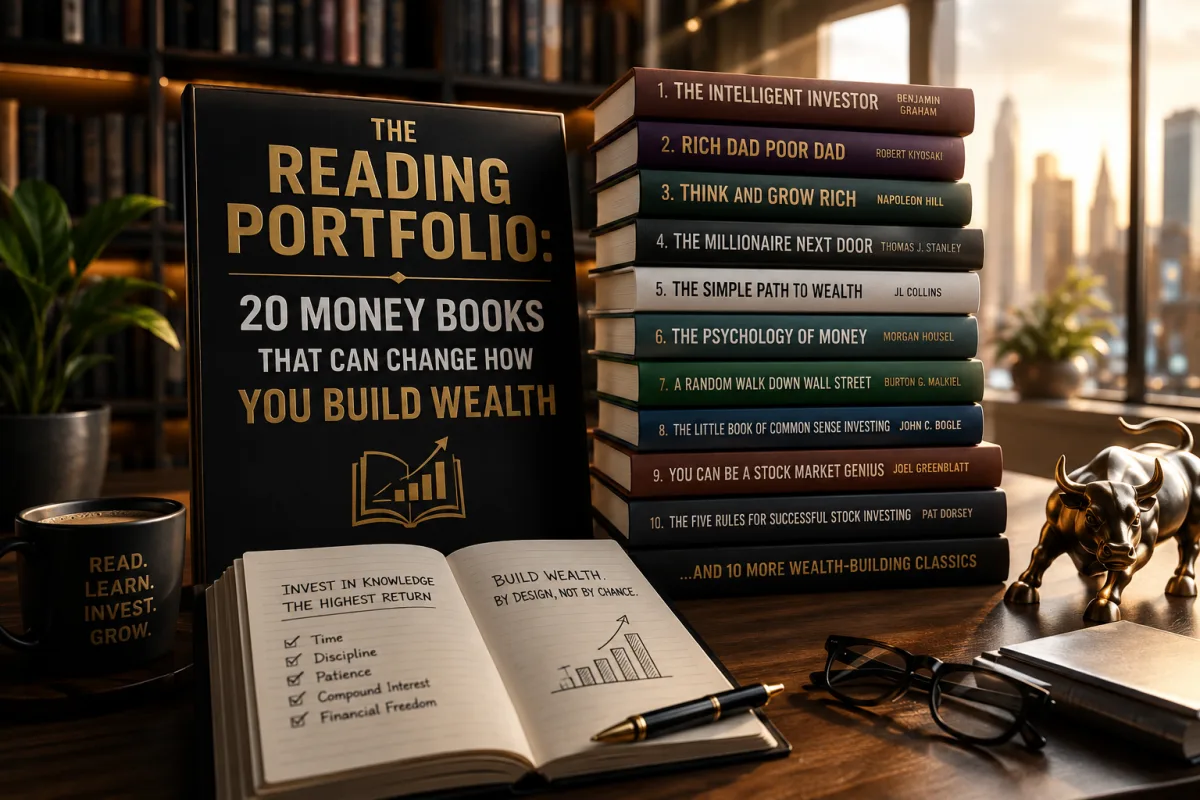
The Reading Portfolio: 20 Money Books That Can Change How You Build Wealth
A good money book can do more than explain finance.
It can change the way a person sees work, spending, debt, investing, ownership, risk, ambition, freedom and time. It can reveal why earning more does not always create wealth. It can show why ordinary people become financially independent while high earners remain fragile. It can teach patience when markets are noisy, restraint when lifestyle pressure rises and courage when investing feels intimidating.
Money books matter because financial education is rarely delivered in the order people need it. Many adults learn about debt after they are already in debt. They learn about investing after missing years of compounding. They learn about taxes after penalties. They learn about lifestyle inflation after raises have disappeared. They learn about financial independence only after decades of paycheck dependence.
The right book can shorten that learning curve.
But not all money books serve the same purpose. Some books teach behavior. Some teach investing. Some teach debt control. Some teach financial independence. Some teach business ownership. Some teach how markets work. Some teach mindset. Some are technical. Some are simple. Some are timeless. Some are useful but need to be read with caution because their advice depends on country, tax rules, personality, market conditions or financial stage.
The best personal finance library should not be built from one author or one philosophy. It should be built like a portfolio. You need books that teach defensive habits and books that teach growth. Books that challenge spending and books that explain investing. Books that warn against speculation and books that encourage ownership. Books that help beginners take action and books that help experienced investors think clearly.
The goal is not to agree with every sentence in every book. The goal is to become a better financial thinker.
The 20 books below can change a financial future because they address the forces that shape wealth: behavior, income, savings, compounding, risk, debt, markets, business, psychology and purpose. Each book has a different strength. Together, they form a practical education in how money works in real life.
1. The Psychology of Money by Morgan Housel
The Psychology of Money is one of the most important modern personal finance books because it explains that financial success is not only about intelligence, spreadsheets or technical skill. It is about behavior.
Many people assume wealth comes from knowing more than everyone else. Housel’s central message is different: how people behave with money often matters more than how much financial theory they know. Patience, humility, risk awareness, emotional control, savings discipline and knowing what is enough can matter more than complex strategies.
This book is especially useful because it makes money personal. People make financial decisions based on their childhood, family history, fears, culture, income experience, luck, trauma, ambition and social environment. Two people can look at the same investment and react differently because they have lived different financial lives.
The book teaches that wealth is often invisible. Spending is visible. Cars, houses, clothes and holidays can be seen. Savings, investments and restraint are harder to see. This distinction is powerful because many people damage their finances trying to look wealthy before they are wealthy.
The practical lesson is to build a financial life that can survive uncertainty. Save more than seems necessary. Avoid ruin. Respect luck and risk. Do not chase status. Let compounding work. Define enough before ambition becomes destructive.
This book is ideal for anyone who knows what they should do financially but struggles to do it consistently. It teaches that the greatest financial edge may be temperament.
2. The Millionaire Next Door by Thomas J. Stanley and William D. Danko
The Millionaire Next Door is valuable because it challenges the popular image of wealth.
Many people imagine millionaires as luxury consumers living in expensive neighborhoods, driving prestige cars and spending freely. Stanley and Danko studied affluent households and found a different pattern: many wealthy people live below their means, avoid status spending, save consistently, invest wisely and build net worth quietly.
The book’s strength is that it separates looking rich from being rich. A person with expensive possessions may have little wealth if those possessions are financed by debt. A person with a modest lifestyle may have significant wealth because they own assets and control expenses.
The lesson is simple but uncomfortable: wealth is often built by people who do not feel the need to prove it.
This book is particularly useful for readers vulnerable to comparison. It shows that the path to wealth may involve driving a less impressive car, living in a more affordable home, buying fewer status symbols and investing the difference. The result may not impress everyone immediately, but it strengthens the balance sheet.
The practical application is to track net worth, not lifestyle. Ask whether spending decisions increase freedom or merely create appearances. Focus on assets, savings rate and financial independence rather than social signals.
The Millionaire Next Door remains powerful because it teaches that ordinary discipline can produce extraordinary wealth.
3. Your Money or Your Life by Vicki Robin and Joe Dominguez
Your Money or Your Life is one of the most influential books for people who want to connect money with meaning.
The book asks readers to see money as life energy. Every purchase represents time, effort, attention and freedom exchanged for something. This changes the spending question. Instead of asking only whether something is affordable, the reader begins asking whether it is worth the life energy required to buy it.
This idea can be transformative because many people spend unconsciously. They trade hours of work for purchases that bring only brief satisfaction. They increase expenses, then need more income, then work more, then spend more to recover from the stress of work. The cycle can continue for decades.
Your Money or Your Life helps readers interrupt that cycle by examining the relationship between money, work and fulfillment. It is not merely about budgeting. It is about asking what kind of life money should support.
The book is especially relevant for people interested in financial independence. It shows that reducing unnecessary spending has two benefits: it increases savings and reduces the amount needed to live freely. The less money required for a satisfying life, the faster financial independence becomes possible.
The practical lesson is to track spending honestly, calculate the true cost of work, identify what spending genuinely improves life and redirect money toward freedom rather than habit.
This book can change a financial future because it shifts the goal from earning more endlessly to living deliberately.
4. The Simple Path to Wealth by JL Collins
The Simple Path to Wealth is valuable because it makes investing feel less intimidating.
Many beginners avoid investing because they believe it requires constant analysis, stock picking, market timing or expert knowledge. Collins argues for a simpler approach built around broad stock market index funds, low costs, patience and avoiding unnecessary complexity.
The book’s strength is clarity. It explains why owning a broad slice of productive businesses can be a powerful long-term wealth strategy. Instead of trying to outsmart the market, the investor participates in market growth over time. Instead of reacting to headlines, the investor stays disciplined.
This book is especially useful for people who overcomplicate investing before they begin. Complexity can become procrastination. A simple, diversified, low-cost investment plan that is actually followed is often better than an impressive plan that is never started.
The practical lesson is to focus on savings rate, broad diversification, low fees and long time horizons. Avoid panic selling. Avoid chasing hot tips. Avoid paying for complexity that does not improve results.
The book is not a complete financial plan for every investor because tax rules, available funds and retirement systems differ by country. But its core philosophy is broadly useful: simple investing can be powerful when combined with discipline.
5. The Intelligent Investor by Benjamin Graham
The Intelligent Investor is one of the classic texts of value investing.
Benjamin Graham teaches investors to think like owners, not speculators. Instead of buying securities because prices are rising or because the crowd is excited, the intelligent investor studies value, risk, business quality and margin of safety.
The idea of margin of safety is one of the book’s most important contributions. It means buying with enough room for error. Since the future is uncertain, investors should not depend on perfect forecasts. A margin of safety protects against mistakes, market declines and overoptimistic assumptions.
The book also introduces the emotional character of markets. Prices move because investors are fearful, greedy, impatient, hopeful and reactive. Graham’s famous idea of the market as a moody business partner teaches investors not to treat every price movement as truth. Sometimes the market offers attractive prices. Sometimes it offers foolish prices. The investor must remain rational.
The Intelligent Investor is not always easy reading for beginners, and some examples are dated. But its principles remain valuable: distinguish investing from speculation, demand a margin of safety, control emotion, avoid overpaying and think independently.
The practical lesson is that successful investing is not about constant excitement. It is about discipline, valuation, patience and protection from permanent loss.
6. The Richest Man in Babylon by George S. Clason
The Richest Man in Babylon is simple, memorable and still useful because it teaches timeless money principles through stories.
The book’s core lesson is to pay yourself first. A portion of everything earned should be kept. This sounds basic, but it is the foundation of wealth. A person who spends all income, regardless of how much they earn, cannot build assets. A person who consistently keeps part of income creates the seed of future wealth.
The book also teaches living below means, seeking wise counsel, protecting capital, investing carefully and increasing earning ability. These lessons are presented in an old-fashioned style, but the principles remain practical.
The strength of this book is that it makes wealth building feel understandable. It does not begin with complex investment products. It begins with habits: save, control spending, avoid foolish risk, make money productive and learn how to earn more.
This book is especially useful for beginners because it reinforces the idea that wealth starts with behavior before strategy. Without the habit of keeping part of income, no investment method can help for long.
The practical lesson is to save before spending, avoid lifestyle excess, invest only in what you understand and treat earning power as something to develop.
7. The Automatic Millionaire by David Bach
The Automatic Millionaire is built around a powerful idea: automate good financial behavior.
Many people fail financially not because they lack good intentions, but because good intentions are weak systems. They plan to save after spending. They plan to invest when they remember. They plan to pay extra on debt when money is available. But life gets busy, emotions interfere and money disappears.
Bach’s solution is automation. Pay yourself first automatically. Automate retirement contributions. Automate debt payments. Automate savings. Make wealth-building behavior happen before daily life can interrupt it.
The book is especially helpful for people who struggle with consistency. It recognizes that willpower is unreliable. Systems are stronger. If money moves automatically to savings and investments, the person adjusts spending around what remains.
The practical lesson is to design finances so the right action happens by default. The earlier saving and investing are automated, the less effort is required to maintain discipline.
Some examples and product references may vary by country, but the central principle applies widely. Wealth becomes easier when the system does not depend on constant motivation.
8. I Will Teach You to Be Rich by Ramit Sethi
I Will Teach You to Be Rich is useful because it combines automation, conscious spending and practical financial systems.
Sethi’s approach is not extreme frugality. Instead, he encourages readers to spend generously on what they truly value while cutting mercilessly on what they do not. This distinction is important because many people think financial discipline means saying no to everything. A better system says no to low-value spending so that money is available for high-value goals.
The book covers banking, credit cards, debt, investing, negotiation and automation in an accessible way. Its tone is direct and modern, which makes it helpful for readers who find traditional finance books dry or intimidating.
The strongest lesson is that personal finance should be designed as a system. Accounts, transfers, investments, bills and spending categories should work together. Once the system is built, money decisions become less chaotic.
The practical application is to automate savings and investments, negotiate fees, optimize accounts, invest consistently and spend intentionally rather than emotionally.
This book is especially helpful for young professionals and beginners who want a practical structure for managing money without becoming obsessed with every small expense.
9. The Total Money Makeover by Dave Ramsey
The Total Money Makeover is best known for its strong stance against consumer debt.
Ramsey’s approach is direct: build a starter emergency fund, attack debt aggressively, avoid borrowing for lifestyle and create financial stability through discipline. His debt snowball method focuses on paying off the smallest debts first to build motivation, even if the highest-interest debt would be mathematically optimal.
The book is useful for people overwhelmed by debt because it gives a clear sequence. Debt can create emotional exhaustion. A simple plan can restore momentum. For many readers, the psychological victory of eliminating balances one by one matters more than perfect math.
Some readers may disagree with parts of Ramsey’s philosophy, especially around all forms of debt or investment assumptions. That is reasonable. The book should be read as a behavioral debt-recovery manual, not as the only financial philosophy anyone needs.
The practical lesson is that high-interest consumer debt destroys freedom. A person who wants wealth must stop using debt to fund lifestyle, build emergency savings and redirect payments toward financial progress.
This book can be especially valuable for anyone who needs structure, urgency and motivation to escape debt.
10. The Bogleheads’ Guide to Investing by Taylor Larimore, Mel Lindauer and Michael LeBoeuf
The Bogleheads’ Guide to Investing is a practical introduction to the investing philosophy inspired by John C. Bogle.
The central ideas are low-cost investing, diversification, simplicity, tax awareness and long-term discipline. Instead of trying to beat the market through constant trading or stock selection, the Bogleheads approach emphasizes owning broad diversified funds and keeping costs low.
This book is valuable because it teaches investors how to think systematically. Asset allocation matters. Costs matter. Taxes matter. Behavior matters. The investor does not need to predict every market movement to build wealth.
The book is especially useful for people who want a practical investment framework rather than a motivational money book. It helps readers understand why a simple portfolio can be more effective than a complicated one.
The practical lesson is to build a diversified plan, avoid unnecessary fees, rebalance when needed, stay the course and resist the temptation to chase performance.
Some account-specific advice may be more relevant in certain countries than others, but the investing principles are broadly useful.
11. The Little Book of Common Sense Investing by John C. Bogle
The Little Book of Common Sense Investing is one of the clearest arguments for index investing.
Bogle’s core message is that investors as a group receive the market return before costs, but after costs many underperform. Since costs reduce returns, investors can improve their odds by owning broad market index funds at low cost and holding them for the long term.
The book is important because it challenges the financial industry’s preference for complexity. Many investors are sold the idea that success requires constant activity, expert forecasts and expensive products. Bogle argues that simplicity and low cost can be powerful advantages.
This book is especially useful for investors who are tempted to trade frequently or chase active managers. It reminds readers that every fee, commission and unnecessary transaction comes out of the investor’s return.
The practical lesson is to capture market returns efficiently, reduce costs, diversify broadly and allow compounding to work.
Common sense investing is not exciting, but that is part of its strength. It is designed to build wealth quietly rather than entertain the investor.
12. A Random Walk Down Wall Street by Burton G. Malkiel
A Random Walk Down Wall Street explains why beating the market consistently is difficult.
Malkiel discusses market efficiency, speculation, bubbles, technical analysis, fundamental analysis, diversification and index investing. The book helps readers understand why many professional and individual investors struggle to outperform broad markets over long periods.
Its value is educational. It gives investors historical context and shows how markets can become irrational. It also explains why diversification and low-cost investing are sensible for many people.
This book is helpful for readers who want to understand why investing is hard before they risk serious money. It reduces overconfidence. Many beginners believe they can pick winning stocks easily. A Random Walk Down Wall Street shows why that confidence should be tested.
The practical lesson is to respect markets, diversify, control costs and avoid assuming that recent performance or clever stories guarantee future returns.
It is a strong book for anyone who wants to become less vulnerable to investment hype.
13. One Up On Wall Street by Peter Lynch
One Up On Wall Street offers a different investing perspective from pure index-fund books.
Peter Lynch argues that ordinary investors can sometimes notice promising companies through everyday life before Wall Street fully appreciates them. But the book is not simply about buying what you like. Lynch emphasizes research, understanding businesses, studying earnings, avoiding hype and knowing why you own a stock.
The book is valuable because it teaches investors to think about companies as businesses. Products, customers, growth, balance sheets, competition and valuation matter. A stock is not merely a ticker symbol. It represents ownership in a real enterprise.
This book is useful for readers interested in individual stock investing. It shows that stock picking requires curiosity and work. It also teaches humility because not every good product is a good investment and not every exciting story becomes a profitable company.
The practical lesson is to invest in what you can understand, but do the research. Do not confuse familiarity with analysis. Do not buy merely because a company is popular. Understand the business case.
For many investors, this book can complement index investing by improving business judgment.
14. The Essays of Warren Buffett edited by Lawrence A. Cunningham
The Essays of Warren Buffett gathers Buffett’s shareholder letters into a structured education on business, investing and corporate behavior.
The book is valuable because it teaches investing from the perspective of business ownership. Buffett focuses on durable competitive advantages, management quality, capital allocation, intrinsic value, patience, shareholder alignment and rational decision-making.
Many investors think of the stock market as a place to trade prices. Buffett teaches readers to think of it as a place to buy pieces of businesses. That shift changes everything. The investor begins asking whether the business is understandable, whether management is trustworthy, whether capital is used wisely and whether the price makes sense.
The book is not a simple beginner manual. It rewards careful reading. But it is one of the best resources for developing long-term investment judgment.
The practical lesson is to think like an owner, avoid unnecessary activity, value quality, understand incentives and prefer patience over speculation.
This book is especially helpful for readers who want to understand how great investors think beyond formulas.
15. Rich Dad Poor Dad by Robert Kiyosaki
Rich Dad Poor Dad is one of the most debated personal finance books, but it remains influential because it introduced many readers to the language of assets, liabilities and cash flow.
The book’s strongest idea is that people should focus on acquiring assets that produce income rather than spending all earnings on liabilities and consumption. It encourages readers to think about ownership, entrepreneurship, financial education and cash-flow-producing investments.
Its value is motivational and conceptual. It can help readers stop seeing a paycheck as the only path to money. It encourages a shift from employee-only thinking toward investor and business-owner thinking.
However, the book should be read with caution. It is not a detailed investment manual. Some examples are simplified. Readers should not use it as permission to take reckless debt, buy property without analysis or assume all traditional financial advice is wrong.
The practical lesson is to learn the difference between income-producing assets and lifestyle liabilities. Use the book as a mindset spark, then study investing, accounting, taxes, debt and risk from more technical sources.
This book can change a financial future if it moves the reader from consumption to ownership, but it should be paired with disciplined analysis.
16. Think and Grow Rich by Napoleon Hill
Think and Grow Rich is a classic mindset book rather than a technical finance book.
Its focus is desire, persistence, faith, planning, decision-making and association with ambitious people. It argues that success begins with clarity of purpose and disciplined thought. Many entrepreneurs and wealth builders have found it motivating because it emphasizes agency and determination.
The book is useful when read as a psychology and ambition text. It can help readers become more intentional about goals, environment and persistence. Financial success often requires more than technical knowledge. It requires discipline, resilience and a willingness to keep acting despite setbacks.
But the book should not replace practical financial education. Positive thinking alone does not build wealth. A person still needs budgeting, income growth, saving, investing, risk management, tax planning and sound decision-making.
The practical lesson is to define financial goals clearly, build persistence and surround yourself with people who support growth. Then combine that mindset with real financial systems.
Think and Grow Rich is most useful when it inspires action, not fantasy.
17. Broke Millennial by Erin Lowry
Broke Millennial is a practical book for younger adults and beginners who want to understand money without feeling judged.
It addresses real-life financial issues: budgeting, awkward money conversations, debt, splitting expenses, financial independence from parents, social pressure, credit and early investing. Its strength is that it meets readers where they are.
Many personal finance books assume the reader already has confidence with money. Broke Millennial recognizes that many people feel embarrassed, confused or behind. It explains financial basics in a conversational way while still encouraging responsibility.
The book is especially helpful for people navigating early adulthood, first jobs, roommates, relationships, student loans or social spending pressure. It makes money less mysterious and more manageable.
The practical lesson is to face money directly. Talk about it. Track it. Make plans. Understand debt. Build credit carefully. Start investing when ready. Avoid letting shame prevent progress.
This book can change a financial future because it helps beginners move from avoidance to action.
18. The Index Card by Helaine Olen and Harold Pollack
The Index Card is built around the idea that good personal finance advice can fit on a small card.
The book emphasizes simple rules: save regularly, invest in low-cost diversified funds, avoid credit card debt, buy appropriate insurance, beware of financial advisers with conflicts, support tax-advantaged savings where available and keep financial life understandable.
Its value is simplicity. Many people believe finance must be complicated, so they delay action or outsource all decisions without understanding them. The Index Card argues that the core principles are not complicated. The difficulty is applying them consistently.
This book is useful for readers overwhelmed by too much financial information. It cuts through noise and focuses on the basics that matter most for many households.
The practical lesson is to master fundamentals before chasing sophistication. Save, invest simply, avoid bad debt, insure major risks, understand incentives and keep costs low.
A simple plan followed consistently can outperform a complicated plan ignored or misunderstood.
19. The Barefoot Investor by Scott Pape
The Barefoot Investor is popular because it gives readers a practical household money system.
Pape’s approach focuses on setting up accounts for different purposes, automating money flow, eliminating debt, building emergency savings and creating financial confidence. Although some details are specific to Australia, the broader structure is useful anywhere.
The book’s strength is behavioral design. It recognizes that people need systems, not just advice. Separating money into different accounts makes it easier to see what is available for bills, daily spending, emergencies and long-term goals.
This is valuable because many people accidentally spend future obligations. They look at one bank balance and assume the money is available, forgetting rent, school fees, tax, insurance or repairs. A structured account system prevents that confusion.
The practical lesson is to organize cash flow. Give money separate jobs. Automate good habits. Attack debt. Build security before complexity.
The Barefoot Investor is especially useful for households that need a clear, repeatable system rather than abstract financial theory.
20. Die With Zero by Bill Perkins
Die With Zero is different from many wealth-building books because it challenges excessive saving without purpose.
Most personal finance books teach people to save more, invest more and delay gratification. That is necessary for many readers. But Perkins asks an important question: what if some people delay too much and fail to use money for meaningful life experiences while they still have health, time and relationships?
The book argues that money should be used intentionally across life stages. Certain experiences are more valuable when enjoyed at the right age. Travel, family time, adventure, learning, generosity and memory-making may have windows that do not stay open forever.
This book should not be read as permission to spend recklessly. It is most useful for people who already save well or who risk becoming so focused on accumulation that they forget the purpose of money.
The practical lesson is to balance wealth building with life design. Save enough for security, independence and responsibility, but do not postpone all joy until a future that is not guaranteed.
Die With Zero adds an important question to financial planning: are you using money to build a life, or only using life to build money?
How to Read Money Books Without Getting Confused
Reading money books can become confusing because different authors give different advice.
One author may say avoid all debt. Another may say use debt strategically. One may say buy index funds. Another may say study individual companies. One may emphasize extreme saving. Another may encourage spending on meaningful experiences. One may focus on mindset. Another may focus on technical investing.
This does not mean the books are useless. It means context matters.
A person drowning in credit card debt may need The Total Money Makeover more than a stock-picking book. A person with no debt and a high savings rate may need The Simple Path to Wealth. A person earning well but spending for status may need The Millionaire Next Door. A person financially secure but afraid to enjoy money may need Die With Zero. A person making emotional investment decisions may need The Psychology of Money.
The right book depends on the reader’s current problem.
Do not read every book as a command. Read each as a lens. Ask what problem the author is solving, what assumptions they make, what country or financial system they are writing from, what risks they may understate and which principles apply to your situation.
Financial wisdom is not copying one person’s rules. It is learning how to make better decisions.
The Best Reading Order for Beginners
A beginner should start with behavior before technical investing.
First, read The Psychology of Money to understand why behavior drives outcomes. Then read The Richest Man in Babylon or The Automatic Millionaire to build the habit of saving first. Then read The Millionaire Next Door to separate wealth from appearances. Then read Your Money or Your Life to connect money with freedom and life energy.
After that, move into practical systems. I Will Teach You to Be Rich, Broke Millennial, The Barefoot Investor and The Index Card can help readers organize accounts, automate savings, manage credit and build confidence.
Then study investing. The Simple Path to Wealth, The Bogleheads’ Guide to Investing, The Little Book of Common Sense Investing and A Random Walk Down Wall Street provide a strong foundation in diversification, index funds, market behavior and long-term discipline.
Once the basics are strong, read The Intelligent Investor, One Up On Wall Street and The Essays of Warren Buffett to deepen business and investing judgment.
Finally, read Die With Zero when the question becomes not only how to build wealth, but how to use wealth well.
This order helps readers avoid a common mistake: studying advanced investment ideas before mastering saving, debt, spending and behavior.
The Four Lessons These Books Share
Although these books differ, many of them point toward the same four lessons.
The first lesson is that behavior matters. Money is not only math. Patience, discipline, humility and emotional control shape outcomes.
The second lesson is that wealth requires surplus. A person must spend less than they earn and direct the difference toward savings, debt reduction and assets.
The third lesson is that ownership builds wealth. Cash flow from labor is important, but long-term wealth comes from owning productive assets: businesses, funds, shares, property, bonds, intellectual property or income-producing systems.
The fourth lesson is that time changes everything. Compounding, career growth, debt repayment, learning and reputation all reward consistency over years.
These lessons are simple, but they are not easy. The books are valuable because they explain the same truths from different angles until the reader begins to act differently.
Turning Reading Into Financial Progress
Reading a money book does not change a financial future by itself.
The reader must convert ideas into actions. After finishing a book, choose one practical step. Automate a savings transfer. Calculate net worth. Build a debt repayment plan. Open an investment account. Review insurance. Cancel low-value spending. Increase retirement contributions. Start a sinking fund. Negotiate a bill. Read an investment statement. Have a money conversation with a partner.
Knowledge becomes wealth only when it changes behavior.
A useful habit is to keep a money notebook. For each book, write three lessons, one warning and one action. The action is the most important part. A person who reads 20 books but changes nothing has collected information. A person who reads one book and changes one major habit has begun building wealth.
Financial education should reduce confusion, not become another form of procrastination.
Final Thoughts
The best money books do not merely teach people how to make more money. They teach people how to think differently about money.
They show that wealth is not the same as income. They reveal the danger of lifestyle inflation. They explain why debt can trap future earnings. They teach how compounding rewards patience. They show why low-cost diversified investing is powerful. They warn against speculation and overconfidence. They remind readers that money should serve life, not replace it.
The 20 books in this list can change a financial future because each one attacks a different weakness. Some attack ignorance. Some attack fear. Some attack debt. Some attack status spending. Some attack investment complexity. Some attack impatience. Some attack the belief that wealth is only for other people.
Read them slowly. Apply them deliberately. Do not try to become a perfect investor in one month. Start by becoming a better steward of the next paycheck, the next debt payment, the next savings transfer, the next investment contribution and the next spending decision.
A strong financial future is rarely built from one idea. It is built from repeated exposure to sound principles and repeated action on those principles.
A good money book can change how you think. A changed way of thinking can change how you behave. Changed behavior, repeated long enough, can change your financial life.

